How MATs Can Reduce Website Compliance Risk Across Their Schools
How MATs Can Reduce Website Compliance Risk Across Their Schools

If you run a multi academy trust, website compliance isn’t one job. It’s the same job repeated across every school you’re responsible for, and that repetition is where the risk actually sits.
The scale makes the point. Of the 10,970 academies open at 31 August 2024, 9,869 sat inside a trust with more than one academy, which is 90 per cent of all academies. The mean trust runs nine academies and the median six, across 1,161 trusts (DfE, Academy Schools Sector in England: Consolidated Annual Report and Accounts, year ended 31 August 2024). So when something a school must publish gets missed, it usually isn’t missed once. It’s missed six or nine times, on separate websites, by people who each assumed someone else had it covered.
So this post covers what academy trusts must publish, how trust duties differ from school duties, what changed in the Academy Trust Handbook 2026, where our audits show schools actually lose marks, and six moves that reduce the risk across every school at once.
The short answer on multi academy trust website compliance
Here’s what actually works. Academy trusts that keep every school compliant do four things:
- One standard, written down. A single trust definition of a compliant school website, so nobody interprets DfE guidance from scratch twelve times over.
- Publish trust-level information once. Governance, executive pay, the funding agreement, whistleblowing. These belong to the trust, so they sit on the trust website and get linked from each school, not rewritten per site.
- One calendar of dated duties. Most statutory publishing has a deadline attached. Put them in one place with an owner against each.
- Audit on a cycle, not before an inspection. Compliance drifts quietly, and a termly check catches it while it’s small.
What academy trusts must publish on a multi academy trust website
There are two overlapping sets of requirements, and confusing them causes more gaps than anything else. Each academy school must publish its own statutory information. The trust, as the legal entity, has separate ones. Both have to be met.
The DfE guidance sits on the page “What academies and further education colleges must or should publish online”. Note the date: as at 31 August 2026 it still shows “Last updated 24 October 2024”, as does the equivalent page for maintained schools. The DfE requirements haven’t changed since. The Academy Trust Handbook, where most trust-level duties live, is a different story.
What every academy school must publish on its school website
Each academy school publishes broadly what maintained schools must publish, with a few differences. In short, schools must publish information covering:
- Admission arrangements, which schools must publish following the School Admissions Code and the appeals code, with three separate dates to meet.
- Curriculum content for every subject each academic year, including relationships and sex education, and phonics or reading schemes at key stage 1.
- Test, exam and assessment results, as a link to the compare school and college performance service, not a home-made performance measures page.
- Ofsted reports, the most recent one or a link to it on the Ofsted website.
- Behaviour policy, including the anti-bullying strategy.
- SEN information report, updated annually, plus the accessibility plan for disabled pupils.
- Pupil premium strategy statement by 31 December, showing how the funding is spent and its impact on disadvantaged pupils.
- PE and sport premium report by 31 July, for academies with primary-aged pupils.
- Public sector equality duty details annually, and equality objectives at least every four years.
- Contact details: schools must publish a postal address, telephone number, the name and contact details of a member of staff for queries, and the headteacher’s name, plus the complaints procedure for parents and carers.
- Ethos and values, plus charging and remissions policies and school opening hours for a typical week.
- Remote education arrangements, what pupils and parents can expect in a typical week of learning at home.
- School uniform policy and costs, and careers programme information for secondary academies, naming the careers lead.
Two deserve a flag now. Remote education and the public sector equality duty are areas where schools reliably assume they’re compliant and reliably are not.
How academy duties differ from maintained schools
Maintained schools must publish information their local authority holds part of the responsibility for, and they defer to the local authority on admissions where it is the admissions authority. Academy trusts must publish their funding agreement, their memorandum and articles of association, and their executive pay bandings, none of which applies to a maintained school. And where DfE says academies should publish rather than must, a trust still needs a position on it, because “should” in statutory guidance is not optional, and inspectors read the same pages you do.
The practical effect on academy websites: a template borrowed from a maintained school will be missing several trust items, and a trust can publish details of its special educational needs provision perfectly well and still fall short on governance.
What the trust itself must publish on the trust website
This is the set central teams own. What academy trusts must publish at trust level sits in the Academy Trust Handbook, not the DfE publish online guidance. The 2026 handbook is effective from 1 October 2026, and its website duties are:
- Governance arrangements (section 1.55). Up-to-date details in a readily accessible format: the structure and remit of members, board of trustees, committees and local governing bodies, which is your scheme of delegation, plus the full name of each chair. Also the register of business and financial interests for members, trustees, local governors and the accounting officer, including nil returns where they apply. And attendance records over the last academic year, for trustees at board and committee meetings and for each local governor.
- Executive pay (section 2.35). The number of employees whose benefits exceeded £100,000, in £10,000 bandings, for the previous year ended 31 August, in a separate readily accessible form. Benefits include salary, employer pension contributions, other taxable benefits and termination payments. An off-payroll arrangement with a non-employee paid over £100,000 goes in too, as if they were an employee.
- Whistleblowing procedure (section 2.48), agreed by the board of trustees and published, protecting staff who report someone they believe is doing something wrong or illegal.
- Keeping governance details current (section 2.54). Notify DfE of changes within 14 calendar days, and update the website and Companies House accordingly. That 14-day clock is the bit most trusts miss.
- Notice to Improve (section 6.21). If DfE issues one, publish it on the trust website within 14 days and keep it there until it’s lifted.
- Governance documents: memorandum and articles of association, the funding agreement and any supplemental funding agreement, and the names of trust members and academy trustees.
- Audited annual report and accounts, published by 31 January each year.
- Gender pay gap information, where the trust has 250 or more employees, within one year of the snapshot date, which is 31 March for most public authorities.
The new 2026 duty: a summary statement of financial information
Here’s the one genuinely new requirement, and it applies to MATs only.
Section 5.32 of the 2026 handbook requires multi academy trusts to publish on their website a summary statement, by 31 January, accompanying the annual accounts, outlining how funds are distributed across their schools. It should match the accounts notes on central services and funds, plus a summary overview of the themes in the DfE example. DfE frames it as increasing transparency on trust financial arrangements, following the Every child achieving and thriving white paper.
It is genuinely new. In the 2025 handbook, section 5.32 covered borrowing and credit cards, and “summary statement” didn’t appear anywhere in it.
On timing, read it carefully. The handbook gives the annual deadline as 31 January and the duty takes effect from October 2026. Neither the handbook nor the guidance prints a first-year date, so don’t quote one. In practice: accounts for the year ending 31 August 2026 must be published by 31 January 2027, and this statement goes with them. That’s the date to work back from.
One thing to hold onto: the handbook moved, the DfE lists didn’t. Trusts that react to every rumoured change rewrite pages that were already compliant.
Why website compliance risk multiplies across a trust
Single schools and academy trusts fail compliance in different ways, and knowing the difference lets a central team fix the cause, not the symptom.
One gap becomes nine
In a standalone school, a missing set of published objectives is one gap. In a trust of nine academies, if the template every school inherited never had that page, it’s nine gaps with one root cause. The reverse is the opportunity: fix the standard once and you fix it nine times. Most central teams have that advantage and don’t use it.
Local variation nobody asked for
Schools personalise. Healthy for ethos and values, unhelpful for statutory information. One files its policies under Key Information, another under Parents, a third under About Us. Nothing is technically missing. But a parent, trustee or inspector hunting the SEN information report on four sites has four experiences, and one will conclude it isn’t there.
The knowledge that walks out of the door
Website compliance is usually held by one person per school, rarely in their job title. When they leave it goes with them: which page holds what, which document is out of date. We’ve written about handing over school website management properly. In a trust the fix is structural: if the standard and calendar live centrally, someone leaving stops being a compliance event.

Where trusts lose marks: evidence from 247 school website audits
This isn’t guesswork. Our State of School Website Compliance 2025 report is built on 247 completed audits across 205 schools, measured against 24 compliance areas using our own audit software. The headline findings:
- Average compliance score: 80.2 per cent. Median 85 per cent.
- Only 6.5 per cent of audits, 16 of 247, came out fully compliant.
- 38.1 per cent scored 90 per cent or above.
- 39.3 per cent scored below 80 per cent.
Most schools are close. Very few are actually there. That’s why we treat website compliance as a maintenance problem rather than a publishing problem, and it’s the basis of the Always Ready approach: the work isn’t writing the pages, it’s keeping them right afterwards. Our write-up of what the 2025 audit data tells us about staying ready has the year-on-year detail.
Here’s where marks actually go, by failure rate across those audits.
Governance information is the biggest single gap
Governance information failed in 49.8 per cent of audits, the most-missed area we measure. For a trust that’s a red flag, because governance is exactly where trust-level duties are heaviest and most specific.
The failures are rarely a missing page. They’re incomplete detail: no scheme of delegation, a committee chair not named, interests published for trustees but not local governors, no nil returns, attendance records missing for the last academic year. Section 1.55 asks for all of it, and a page headed Governance with a list of names does not meet it. Our post on what schools must publish about governance breaks it down.
PE and sport premium
Failed in 46.1 per cent of audits, almost always a date problem rather than a content one. Publication is due by 31 July, the last week of term when everyone is flat out, so last year’s report sits there into the autumn: technically published, actually out of date.
Remote education
Failed in 42.1 per cent of audits. This has quietly become the requirement schools forget exists. Many published something in 2021 and haven’t looked since. The guidance asks what pupils and parents can expect in a typical week, so a page describing systems the school no longer uses does not meet it.
The public sector equality duty and equality objectives
Failed in 38.9 per cent of audits, usually because two duties get conflated. Public sector equality duty compliance details must be updated every year. Equality objectives at least every four years. Schools publish one and not the other, or publish objectives with no date so nobody can tell if they’re current. Pay gap reporting sits nearby at 37.3 per cent.
Admission arrangements
Failed in 34.2 per cent of audits, showing how three deadlines create three chances to slip: determined arrangements by 15 March, in-year by 31 August, appeals timetable by 28 February. Miss one and the area fails even where the other two are perfect. Where the trust is its own admissions authority this is central team work, and treating it as school work is how it gets missed.
Also on the list: SEND information 35.3 per cent, results 34.1 per cent, MAT requirements 32.7 per cent, curriculum 31.8 per cent. At the strong end, Ofsted reports failed in only 1.9 per cent. Schools are good at the visible pages. The statutory detail underneath is what drifts.

Six moves that reduce multi academy trust website compliance risk
These are in order of return on effort. The first two cost academy trusts almost nothing and remove the most risk.
1. Write one trust standard, not twelve interpretations
Produce a single document saying exactly what a compliant school website contains for your trust: every required item, the page it lives on, the menu it sits under, who owns it, and how often it’s reviewed. Not a copy of the DfE guidance. A trust-specific translation of it, with your page names and your owners.
It turns a judgement call into a checklist, and a new headteacher or office manager gets handed one document instead of a conversation.
2. Publish trust-level information once and link to it
Governance arrangements, the register of interests, executive pay bandings, the whistleblowing procedure, the funding agreement, the memorandum and articles of association, the accounts, and now the funds distribution summary statement. Publish them on the trust website, maintain them in one place, and link to them from each school site rather than duplicating them. Every extra copy can go stale, and a stale copy on a school site is a failure even when the trust site is perfectly current.
3. Put every dated duty in one calendar
Almost everything academy trusts must publish carries a date. Pull them into one calendar, per school where the duty belongs to the school, with a named owner against each. Not “the school office”. A person. Set the reminder a fortnight early, because the deadlines cluster at the ends of terms when nobody has capacity. The full date list is in the next section.
4. Standardise where things live
Agree one information architecture for statutory content: same top-level menu item, same page names, same order on every site. Schools keep their identity in everything else. But statutory information should sit in the same place everywhere, which turns trust-wide checking into a job of minutes.
5. Reduce the number of systems you’re maintaining
Schools spread across five platforms means five sets of admin, five ways to update a policy, and no way to see the whole picture. Consolidating is a bigger decision than a compliance one, so we wrote up the benefits, risks and key considerations for trusts moving all school websites to one provider. The compliance argument is that one system gives you one view.
6. Audit on a cycle, not before an inspection
The pattern we see most is a scramble when an inspection is announced. Stressful, expensive in staff time, and it catches problems at the worst moment. A termly check against your own standard turns compliance into maintenance. That’s what Always Ready means in practice: ready, not warned.
Trust-level inspection has raised the stakes. Our posts on what’s changing in multi academy trust inspections and on what Ofsted looks for at trust level in a safeguarding inspection both cover the website implications.
The dated duties to put in one calendar
Every one of these has a deadline. Getting them into a single view, with owners, removes most of the risk that comes from simply forgetting.
The annual report and accounts, and the 31 January cluster
31 January is the busiest date in the trust compliance year. The audited annual report and accounts must be on the trust website by then, and for MATs the funds distribution summary statement goes with them. Both relate to the year ended 31 August, so the work sits with finance and the website step is the last link in a longer chain. Make sure someone owns that link, because a signed set of accounts sitting on a server is not published.
Termly and annual policy dates, including school uniform
Working through the year:
- 28 February. Admission appeals timetable.
- 15 March. Determined admission arrangements for September entry.
- 31 March. Gender pay gap snapshot date, with publication due within one year.
- 31 July. The sport premium report, for academies with primary-aged pupils.
- 31 August. In-year admission arrangements. Also the year end the executive pay disclosure and accounts refer back to.
- 31 December. Pupil premium strategy statement.
- 31 January. Audited annual report and accounts, plus the multi academy trust funds distribution summary statement.
- Annually, no fixed date. SEN information report, public sector equality duty details, curriculum content, school uniform policy and costs, remote education provision, and the Ofsted report if a new one has landed.
- Every four years, at least. Equality objectives.
- Within 14 calendar days. Any change to your governance arrangements, updated on the website, notified to DfE and reflected at Companies House.
- Within 14 days. A Notice to Improve, published on the trust website and retained until lifted.
The two 14-day duties catch trusts out because they’re event-driven, not calendar-driven. A trustee resigns mid-term and the website update is nobody’s priority. Build the website step into your governance change process, so it happens as part of the change.

A multi academy trust website compliance checklist
Use this as the starting point for your own trust standard.
At trust level
- Constitutional documents: memorandum and articles of association, funding agreement and any supplemental agreement, all published.
- The full governance picture: members and trustees named, structure and remit of every board and committee, each chair named, scheme of delegation published, interests register complete with nil returns, attendance records for the last academic year.
- Executive pay in £10,000 bandings above £100,000, in a separate readily accessible form, including off-payroll arrangements.
- Whistleblowing procedure published and current.
- Audited annual report and accounts by 31 January, with the funds distribution summary statement alongside them if you’re a MAT.
- Gender pay gap information, if you have 250 or more employees.
- A working process that updates the website within 14 days of any governance change.
At every academy school
Rather than re-listing every requirement, check each school against the questions where failures cluster:
- Is everything present? Work the list of what schools must publish, above, item by item.
- Is everything dated? SEN information report, equality duty details, curriculum content and remote learning pages must be visibly current, not just present.
- Does every link work? A policy behind a broken link is not published. Check the Ofsted and performance service links too.
- Are the dated duties on time? Pupil premium by 31 December, sport premium by 31 July, and the three admissions dates.
- Is it findable? Statutory information should sit in the same place on every school in the trust.
- Does it match your trust standard? If not, either the site is wrong or the standard is.
For primary schools specifically
- The sport premium report published by 31 July, and it’s this year’s.
- Phonics and reading scheme information published within the curriculum content.
- Key stage 2 results linked via the performance service.
- Where a trust runs both phases, make your standard flag which items apply to which, so primary schools aren’t chasing careers duties.
Common mistakes to avoid
- Assuming trust duties are covered because school sites look fine. Governance, executive pay and the accounts are trust duties, and a perfect set of school websites doesn’t discharge them.
- Duplicating trust information on every school site. It multiplies maintenance and guarantees some copies go stale.
- Publishing without dating. An equality objectives page or SEN information report with no review date can’t be shown to be current. Date everything that has a review cycle.
- Treating a document as published because it’s uploaded. A PDF no page links to is not published, and nor is a policy behind a broken link.
- Forgetting the 14-day governance clock. Trustee and governor changes are the most frequent breach we see, because nothing prompts the website update. Leaving PE and sport premium to the last week of July is the close second, so draft it in June.
- Confusing the two equality cycles. Compliance details annually. Objectives at least every four years. Not the same duty.
- Believing the requirements changed when they didn’t. Both DfE publish online pages still show 24 October 2024. The 2026 handbook added one new duty for multi academy trusts, section 5.32. Everything else is unchanged, and rewriting compliant pages on a rumour wastes time.
- Auditing only the schools you’re worried about. The quiet, well-run school with a long-serving office manager is often the one nobody has checked in three years.
How Schudio helps trusts stay always ready
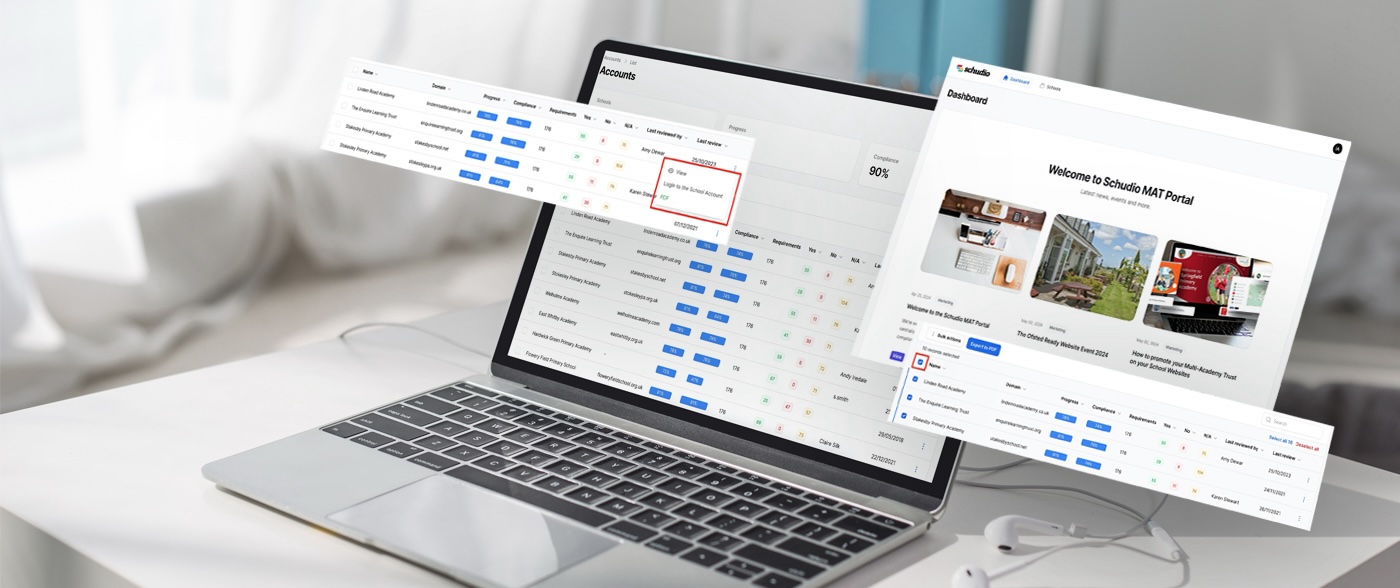
We work with trusts on exactly this problem, and it’s why our MAT Portal exists: one view across every school, so a central team can see compliance status trust-wide instead of opening twelve sites one at a time.
Our School Website Requirements Guide sets out every requirement in plain English and comes with the State of School Website Compliance report, so you can benchmark against the sector. Our trust websites pages explain how the platform handles multi-school management, and you can reach our trust team directly. On the policy side, effective policy management in multi academy trusts and schools is a good companion to this post.
The monthly multi academy trust compliance workshop is the fastest way to get a central team aligned. It’s free, it runs live, and you can bring your own questions.

Frequently asked questions
Is website compliance the trust’s responsibility or each school’s?
Both, and they’re separate duties. Each academy school publishes its own statutory information on its own site. The trust publishes governance information, executive pay bandings, the whistleblowing procedure, the funding agreement, the accounts, and for multi academy trusts the new summary statement. Meeting one set doesn’t meet the other, and the trust board is accountable for both.
What is the new academy trust website requirement for 2026?
Section 5.32 of the Academy Trust Handbook 2026 requires multi academy trusts to publish a summary statement, by 31 January, accompanying the annual accounts, outlining how funds are distributed across their schools. It should match the accounts notes on central services and funds, plus a summary overview of the themes in the DfE example. It applies to multi academy trusts only, and the handbook is effective from 1 October 2026. Section 5.32 in the 2025 handbook covered borrowing instead, so this is a genuine addition.
Have the DfE school website requirements changed recently?
No. As at 31 August 2026 both DfE guidance pages, for maintained schools and for academies and further education colleges, show a last updated date of 24 October 2024. What changed is the Academy Trust Handbook, which added the section 5.32 duty. If you see a claim that the requirements changed this academic year, check the source date before acting on it.
Can a trust publish everything centrally instead of on each school website?
Trust duties, yes, and you should. School duties, no. Each school’s admission arrangements, curriculum content, SEN information report and pupil premium statement belong on that school’s own site. Publish trust-level documents once and link to them prominently from each school.
How often should a trust audit its school websites?
Termly, for a full check against your trust standard, with dated duties handled by calendar reminders in between. Our audit data shows the average school scores 80.2 per cent while only 6.5 per cent are fully compliant, so this is drift, not ignorance. Drift is caught by a cycle.
Which compliance area should a central team fix first?
Governance information. It failed in 49.8 per cent of audits in our 2025 report, and it’s where trust-level requirements are most detailed. It’s also largely central team work, so you can fix it across every school without waiting on twelve people. Then PE and sport premium and remote education.

Related Posts
Ian Richardson
June 24, 2024
Navigating policy management in Multi Academy Trusts (MATs) and schools can be a complex task, ..