The State of School Website Compliance in 2026
The State of School Website Compliance in 2026
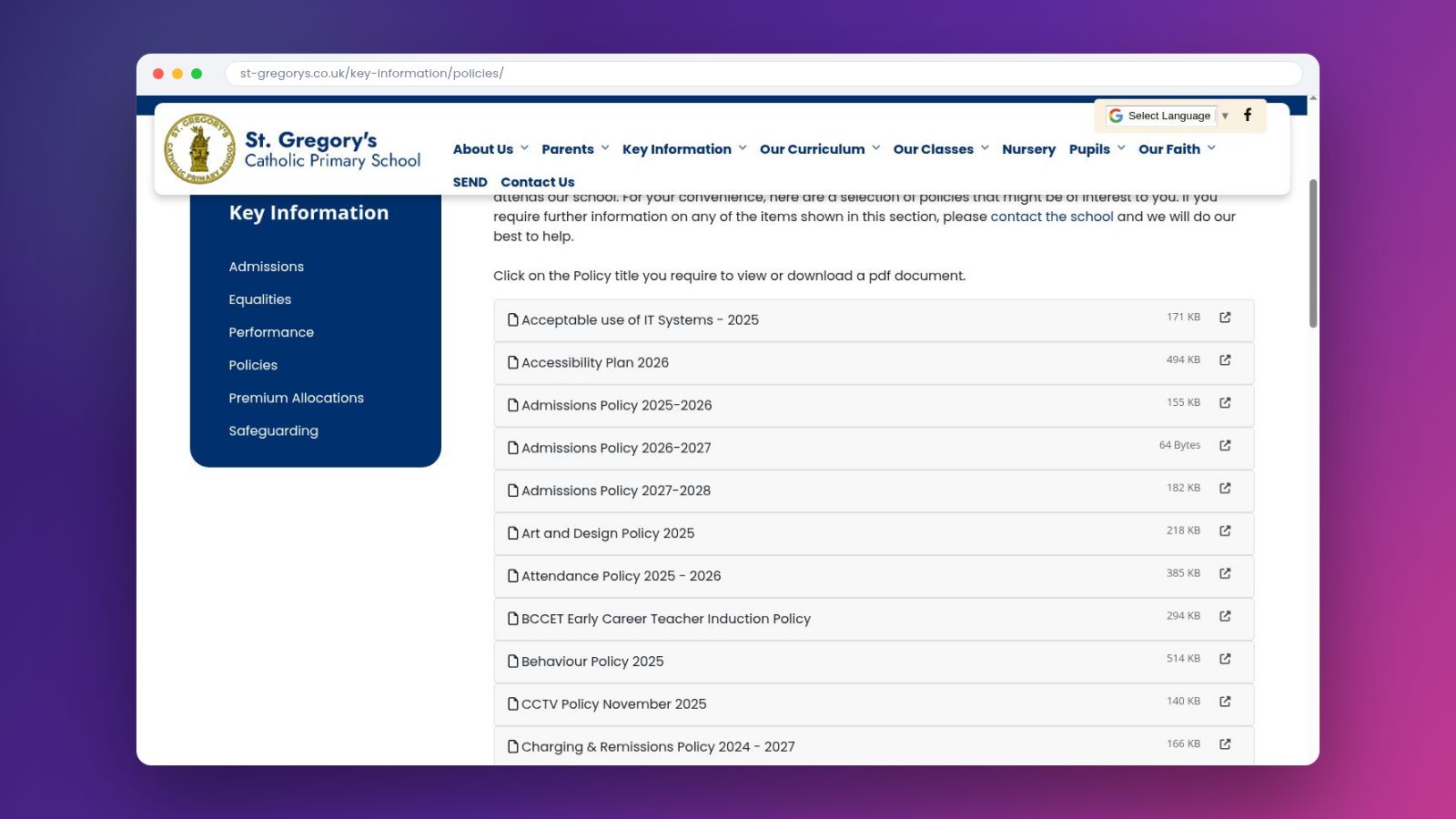
Only 6.5% of the school websites we audited during 2025 were fully compliant.
That is the headline from 247 completed compliance audits carried out through the Schudio system, covering more than 200 schools. The average score was 80.2%. The median was 85%. Almost four in ten scored below 80%.
Read those together and the picture is clear. Most schools are close. Very few are complete.
That is not a publishing problem, it is a maintenance problem. Schools are not failing to build the pages. They are struggling to keep them current across a whole academic year while everything else in school life carries on.
This post sets out what our data shows, what has actually changed for the autumn term, what schools must publish and where the gaps keep appearing. The full findings are in our report, The State of School Website Compliance in 2025.

What has changed since the summer
Three things have moved since we published the 2025 findings. All three land in the autumn term, and none of them appear on the two DfE lists yet.
Branded uniform items are capped from 1 September 2026
Section 35 of the Children’s Wellbeing and Schools Act 2026 inserts a new section 551ZA into the Education Act 1996. From 1 September 2026, a school cannot require more than three different branded items of uniform for a primary pupil. For a secondary pupil the limit is also three, rising to four where one of those items is a tie.
The date comes from the Children’s Wellbeing and Schools Act 2026 (Commencement No. 2) Regulations 2026, SI 2026/803. The DfE updated its statutory guidance, Cost of school uniforms, on 6 July 2026 to reflect it.
Publishing the uniform policy on your site is a should, not a must, and that has not changed. What has changed is the policy itself. If the version you display still describes more branded items than the new limit allows, it is now out of date.
The allergy website duty came into force on 1 September 2026
The DfE published statutory guidance, Allergy safety in schools, on 6 July 2026. It asks schools to create and publish an allergy safety policy.
When this post first went out we said the underlying publishing duty had not been commenced, which was correct at the time. It has since been commenced, and this section has been corrected. Section 34 of the Children’s Wellbeing and Schools Act 2026 was brought fully into force on 1 September 2026 by SI 2026/933, made on 17 August 2026. It inserts section 100A into the Children and Families Act 2014, and section 100A(5)(c) requires you to publish the allergy safety policy on the school’s website. Section 100A also requires the policy to exist and to be reviewed at least once every year.
So this is now a must, in primary legislation. Two things still mislead people. The statutory guidance predates the commencement order by seven weeks and still refers to the publishing duty arriving through forthcoming regulations, which reads as though it is not yet live. And neither DfE publish-online page mentions allergies at all.
Write the policy, publish it, date it and diarise the annual review. If it is not on your website today, that is a live legal gap.
Multi academy trusts have a new duty for January
The Academy Trust Handbook 2026 takes effect on 1 October 2026. Section 5.32 adds one new publishing duty, and it applies to multi academy trusts only.
A trust must publish on its website a summary statement, by 31 January, accompanying the annual accounts, outlining how funds are distributed across its schools. It should match the accounts notes on central services and funds. The first is due by 31 January 2027, alongside the accounts for the year ending 31 August 2026. The DfE published companion guidance, Academy trusts’ financial arrangements: trust summary statement, on 15 July 2026.
And what has not changed
Both DfE pages listing what schools must publish online still show a last updated date of 24 October 2024. Neither mentions branded uniform limits, allergy policies or the trust summary statement, and in the allergy case that is a live legal duty missing from the official list.
That is worth understanding rather than worrying about. The DfE tends to update those two lists last. New duties appear first in the Act, then in commencement regulations, then in statutory guidance and the Academy Trust Handbook, sometimes many months earlier. If you wait for the lists to change before you act, you will always be behind.
Why school website compliance still feels hard
It feels hard because there is so much to manage.
A school website has to serve parents, pupils, staff, governors, trustees, the wider community and inspectors at the same time. It carries contact details, safeguarding information, admission arrangements, the curriculum, policies, complaints procedures, governance detail and trust finances.
Maintained schools follow DfE guidance setting out what they must or should publish. It applies to local authority maintained schools, including primary schools, secondary schools, maintained special schools, maintained nursery schools, voluntary aided schools and voluntary controlled schools.
Academies and academy trusts work to separate guidance covering what academy websites must or should publish. That covers academy trusts, free schools, sixth forms and FE colleges.
The challenge is not really knowing what the guidance says. It is keeping everything current across the whole academic year.
What our 2025 audit data showed
Across 247 completed audits, the average score was 80.2% and the median was 85%.
That is encouraging. Most schools are not starting from nothing, and 38.1% scored 90% or above. But only 6.5% achieved full compliance, 16 audits out of 247, and 39.3% scored below 80%.
A site can look broadly right, with all the expected pages and plenty of useful content. Then you check the detail and find missing documents, old dates, superseded policies, broken links or incomplete statutory content. That is where the risk sits. Not in the obvious gaps, in the detail.
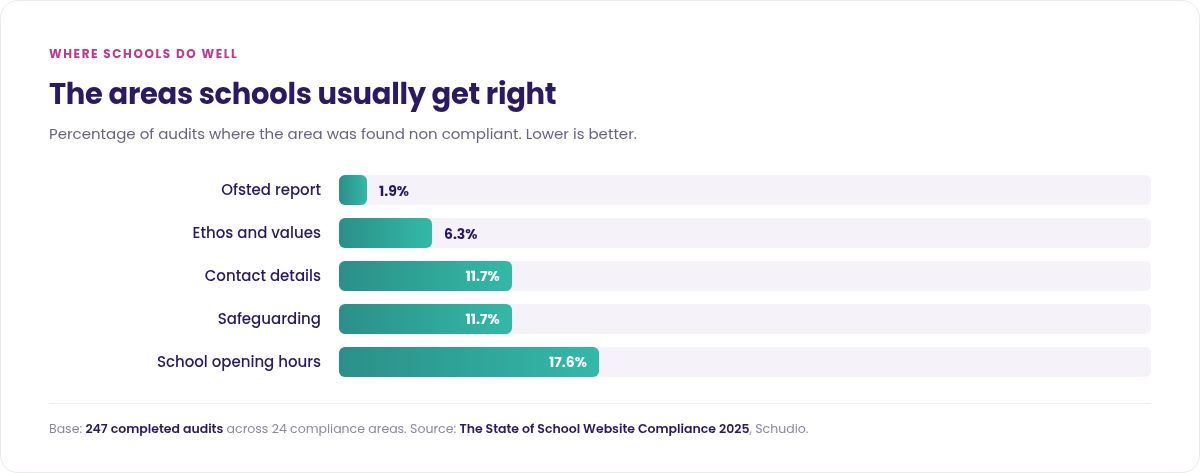
The areas schools usually get right
The strongest areas were the ones that are simpler to publish and easier to spot when they are wrong.
- Ofsted report information, which failed in only 1.9% of audits
- ethos and values, 6.3%
- contact details, 11.7%
- safeguarding information, 11.7%
- school opening hours, 17.6%
That makes sense. These are visible, familiar and used regularly. A missing telephone number gets noticed. An Ofsted report link is straightforward to check. It is good news: most schools already have strong foundations to build on.
The biggest school website compliance gaps
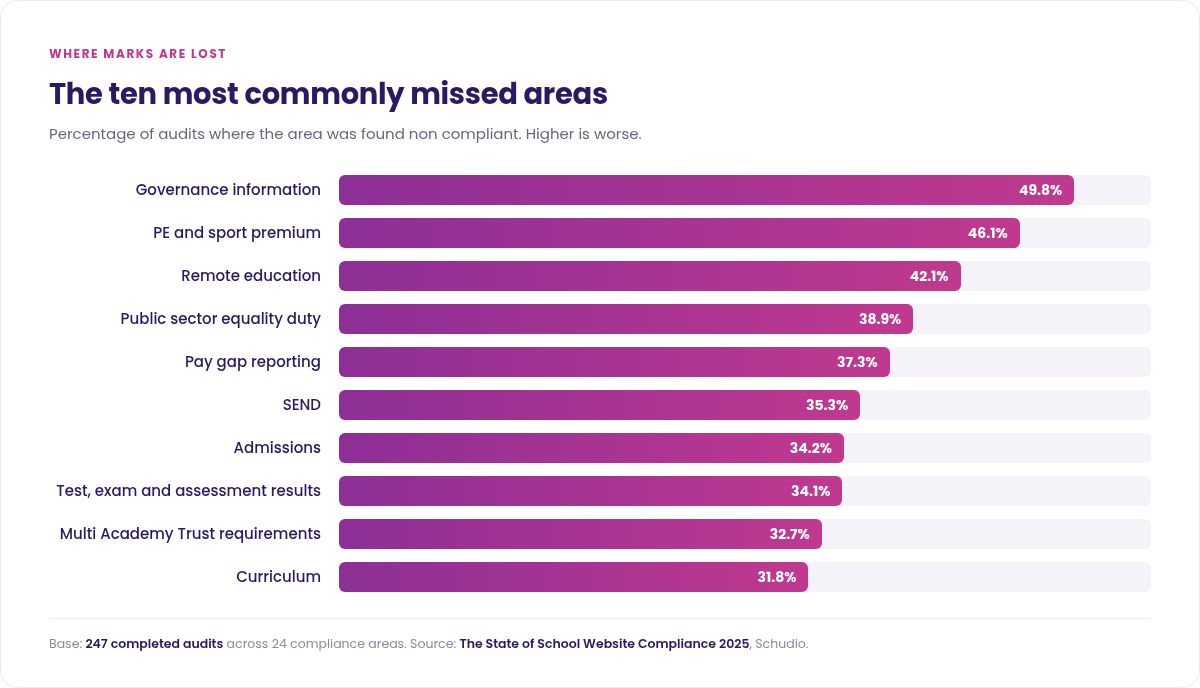
The largest gaps appeared in areas that are more detailed, more time sensitive, or shared across several different people.
- governance information, which failed in 49.8% of audits
- PE and sport premium, 46.1%
- remote education, 42.1%
- public sector equality duty, 38.9%
- pay gap reporting, 37.3%
- SEND, 35.3%
- admissions, 34.2%
- test, exam and assessment results, 34.1%
- Multi Academy Trust requirements, 32.7%
- curriculum, 31.8%
Look at what those have in common. Governance depends on governors, clerks, school leaders or trust teams. PE funding reporting needs an annual review. Pupil premium needs a current strategy statement. SEND detail needs to be current and genuinely useful. Curriculum pages need structure by subject, year group and key stage. Trust content needs clear signposting from every individual site.
None of these are add one link and move on jobs. They need ownership, review, and someone checking the detail.
Compliance rarely fails all at once
The biggest lesson from the 2025 data is that compliance rarely fails all at once. It drifts.
A page is published. Then it is forgotten. Then a date passes. Then a document goes out of date. Then a local authority link changes. Then a staff name is wrong. Then an old policy stays live in one place while a newer version sits somewhere else.
Over time, a site that once looked complete becomes unreliable.
Published, then forgotten, then outdated, then incomplete, then hard to find, then a compliance risk.
That drift is rarely intentional. It usually happens when nobody owns the job of keeping statutory content current.
A website can look complete and still be out of date
A statutory page can exist and still be incomplete. A policy can be uploaded and still be out of date. A document can be available and still be impossible to find.
From a parent’s point of view, information that is hard to find feels like information that is missing. From an inspection point of view, old or inconsistent content creates a poor impression before anyone has spoken to the school.
So a check needs to look past whether a page exists. The real questions are:
- Is the required information current and complete?
- Is it easy to find?
- Are the linked documents the right ones?
- Are review dates still valid?
- Do the page and the policy say the same thing?
- Would parents understand what to do next?
- Is it plain English, and does it meet accessibility requirements?
If you want a structured way to work through this, we have written a step by step guide to completing a website compliance audit.
What schools must publish: key areas to check
The full list depends on your school type, so start with the right guidance and then work through the areas below.
Maintained schools
Maintained schools follow the DfE list of what they must or should publish: contact details, admissions, Ofsted reports, exam and assessment results, the curriculum, behaviour, pupil premium, sport premium, SEND, equality objectives, complaints procedures, charging and remissions, governance and the school’s values and ethos.
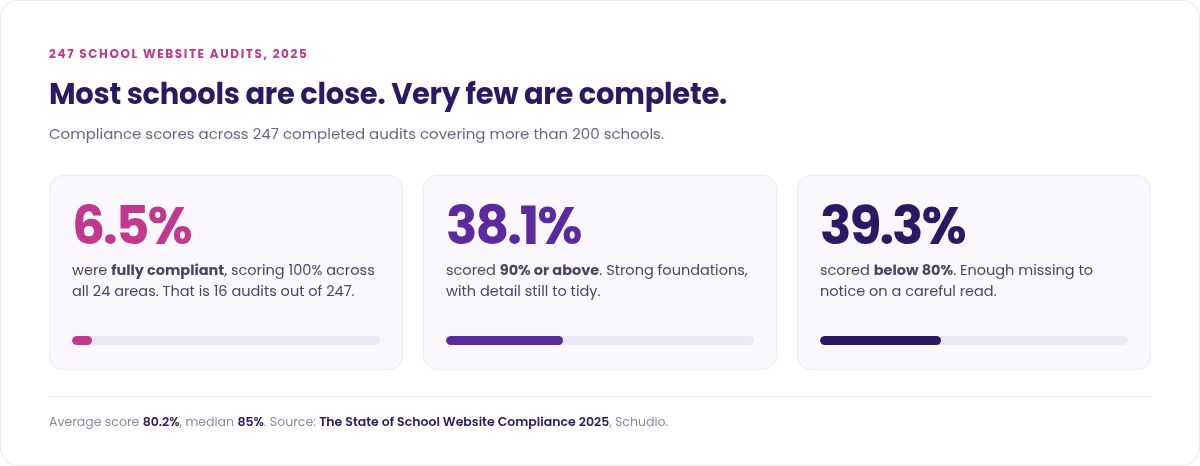
One duty that is easy to miss sits at the end of that list. Schools must provide a paper copy of anything published online to parents and carers free of charge on request. Say so on the site, and name who to ask.
Academies, free schools and academy trusts
An academy or free school follows the separate DfE list, and trusts carry extra duties on top. Those include the funding agreement, the audited annual report and accounts, executive pay, governance across the trust board and its committees, and, from January 2027, the new funds statement.
Contact details
Schools must publish details clearly: the school name, postal address, telephone number and a named contact for queries from parents and the public. Nobody should have to open a document to find that.
Academies should publish trust contact information where required, and each site should make the connection obvious.
Admission arrangements
Admissions is one of the most commonly missed areas, failing in over a third of our audits.
Schools must publish admission arrangements for the normal point of entry by 15 March each year, and keep them available for the whole academic year in which offers are made. In year arrangements must be published by 31 August each year, including whether the school, governing body, academy trust or local authority manages in year applications. By 28 February each year, schools must publish a timetable for how admission appeals will be organised and heard.
Where you link to the local authority, still explain the process on your own page. A bare link is rarely a good experience for a family.
Curriculum, music and key stage information
Curriculum is an area where sites often look full without being clear.
Schools must publish curriculum content that helps parents understand what is taught, when, and how learning is structured, with detail by subject and year group where required. Primary schools should cover key stage 1 phonics and reading schemes. Secondary schools should cover key stage 4 courses, including GCSE English and maths. Settings with 16 to 19 provision should cover the relevant programmes.
Alongside the curriculum itself, all schools are expected to publish a summary of their music development plan, setting out how music is taught and what is offered beyond the classroom. This one is a should rather than a must, and it should be updated before the start of each academic year. It was missing from a great many of the sites we looked at.
Good curriculum pages explain the shape of learning in each key stage. They do not just link to a folder of plans.
SEND and the SEN information report
Schools must publish a SEN information report and review it at least annually.
It should help families understand the types of special educational needs supported, how support is arranged, who to contact and how progress is reviewed.
Schools also need an accessibility plan. It should set out the steps taken to prevent disabled pupils being treated less favourably, how the school will improve physical access for disabled pupils, and how it will make written material more accessible.
This area matters enormously for parent trust. A SEND page should feel clear and reassuring, not like a policy archive.
Safeguarding
Schools must publish safeguarding information in a way that is easy to find: current child protection policy detail, the name and contact details of the Designated Safeguarding Lead, and clear guidance on how to raise a concern.
It is one of the strongest areas in our data, but it still needs checking. Staff change. Policy dates pass. A safeguarding policy published twice, where one version is current and one is two years old, creates immediate concern.
Behaviour policy and complaints procedures
Schools must publish behaviour policy detail. It should be current, clearly dated and easy for parents to find.
They should also publish a complaints procedure explaining how complaints from parents and carers are handled. Do not bury it in a long list of documents. Use plain English and set out the route to follow.
Governance information
Governance was the weakest area in our 2025 data, failing in almost half of all audits.
Schools must publish details of the governing body and its committees: full names, governance roles, terms of office, attendance at body and committee meetings, appointment details and any material interests arising from relationships with other governors or school staff.
Academy trusts must publish the same, and each school should signpost it where the detail sits centrally.
Financial information, executive pay and pay gap reporting
Schools receiving pupil premium funding must publish a strategy statement covering how the funding is spent and the outcomes achieved for disadvantaged pupils. It must be updated annually to reflect current spending and the impact of premium funding in the previous academic year.
PE and sport premium was one of our weakest areas. The usual problems are old statements, missing impact detail and broken links.
Academy trusts must also publish the audited annual report and accounts, and details of employees with a gross annual salary over the relevant threshold. Executive pay needs presenting clearly rather than burying. Where the threshold is met, gender pay gap information must be published too.
Remote education
Remote education failed in 42.1% of our audits, which makes it one of the quietest problems on this list.
Most schools wrote something during the pandemic and have not looked at it since. Check your remote education detail still describes what you would actually do now, that named contacts are current, and that it covers pupils without devices or connectivity.
Public sector equality duty and accessibility
Under the Equality Act, schools must publish a statement setting out how they comply with the public sector equality duty, along with equality objectives that are updated at least every four years. Regularly review both.
Website accessibility sits alongside this. Public sector accessibility regulations require an accessibility statement that is published, current and easily accessible, explaining known issues and how users can report problems. Meeting accessibility requirements is not a technical box tick. It is what lets every parent and carer reach important content.
Careers programme and guidance
Secondary schools should publish their careers programme, including the name and contact details of the careers leader, how the programme is assessed, and how pupils, parents, teachers and employers can access careers guidance. Technical education and apprenticeships providers also need access, and the policy statement covering that should be published where required.
Results, key stage 4 and performance measures
Schools should publish assessment results, exam results and performance measures, including the percentage of pupils achieving the expected standard at key stage 2 and the headline measures for students at key stage 4.
Schools must also link to their school and college performance tables page. Where results are not applicable, for example in some special schools, add a short statement setting out why. That answers the question before it is asked.
Use documents carefully
Documents are often necessary, but they cause a surprising amount of trouble. In audit after audit we see:
- old versions left live alongside new ones
- duplicate policies in different places
- documents with no visible review date
- Word or Excel files uploaded instead of PDFs
- large files that slow the site down
- key content buried inside downloads
- documents that do not meet accessibility requirements
Where you can, put the essentials on the page itself and link to the document for the detail. An admissions page should explain the process in plain English, then link to the full policy and the appeal arrangements. This helps parents, and it makes the site far easier to review.
Use HTML format where possible
One simple improvement is to put more key content directly on the page in HTML rather than inside a PDF.
HTML is easier to read on a phone, easier to search, easier to update and considerably better for accessibility. It is especially worth doing for admissions, SEND, curriculum, safeguarding, behaviour, complaints and your accessibility statement.
Documents still have their place. They just should not be the only route to understanding.
Think like a visitor
A school website is not a compliance filing cabinet. It is where parents, carers, prospective families, inspectors, governors and trustees go to find things out.
If behaviour is a pressure point, is the policy buried in a list of PDFs, or is there a clear page explaining expectations? If admissions are complicated, does the page help a family, or send them away to the council? If a parent wants to picture a typical week, can they find opening hours, routines and the right person to speak to?
That matters for compliance. It matters more for communication.
For academy trusts, visibility matters
For academy trusts the job is bigger. A trust may manage policies centrally, but every school still needs clear signposting.
Trust compliance is not about whether something exists somewhere. It is about whether it is connected properly across every academy website. A trust needs to know which schools are up to date, which have gaps, which requirements are weakest across the group, and whether central content is linked correctly from each site.
Multi Academy Trust requirements failed in 32.7% of our audits, and the new funds statement adds another January deadline to track. That is why a trust wide view is worth having. Our platform built for multi academy trusts is designed around exactly that problem, and our trust team works with central teams on it directly.

The Always Ready approach
Our approach is simple. Schools should feel always ready, rather than waiting for pressure to appear.
That does not mean perfection every day. It means having a system: knowing what needs publishing, putting it in the right place, reviewing key areas across the year, keeping documents under control, checking policy dates, updating when guidance changes, and sharing the work across the right people.
It takes the pressure out of inspection season. We have written more about what that looks like in Ofsted ready school website: always ready, not Ofsted panicked.
Common mistakes to avoid
The same mistakes came up again and again across 247 audits.
- Treating compliance as an annual event. One big check in September leaves eleven months for content to drift.
- Assuming a page exists means the area is done. Most failures we see are incomplete pages, not missing ones.
- Leaving superseded documents live. Two versions of a policy is worse than one out of date version, because nobody can tell which applies.
- Publishing without a review date. If a document does not say when it was last checked, no reader can judge whether to trust it.
- Linking to the council instead of explaining. Common on admissions. It satisfies the letter of the requirement and fails the parent.
- Nobody owning an area. Governance and PE funding fail most often, and both depend on people outside whoever edits the site.
- Forgetting the trust connection. Central publication does not help a parent who cannot find the link.
- Hiding statutory content inside downloads. If the only route is a PDF, it is harder to find, harder to read on a phone and harder to make accessible.
- Ignoring accessibility. An accessibility statement that has never been updated is its own compliance gap.
- Waiting for the DfE lists to change. As uniform, allergy and the trust handbook all show, those two pages update last.
Your compliance checklist
Use this as the starting point for your next review.
- Check the official DfE guidance for your school type.
- Review contact details, including telephone number, postal address and public enquiry contact.
- Check safeguarding, the DSL name and all policy dates.
- Review behaviour and complaints pages.
- Check admissions, in year applications, appeal arrangements and any council links.
- Review the curriculum by subject, year group and key stage.
- Check phonics and reading schemes, and key stage 4 courses where relevant.
- Publish or refresh the music development plan summary.
- Review the SEN information report and the accessibility plan.
- Check public sector equality duty content and equality objectives.
- Review the pupil premium strategy statement and its outcomes.
- Review PE and sport premium detail and impact.
- Check remote education still reflects current practice.
- Check governance, roles, attendance and material interests.
- For trusts, check financial information, executive pay and gender pay gap information.
- Diarise the multi academy trust funds statement for 31 January 2027.
- Review assessment results and the link to performance tables.
- Confirm you offer a paper copy free of charge on request.
- Check the accessibility statement is current.
- Fix broken links and delete superseded downloads.
- Move key content into HTML where you can.
- Record a review date and a named owner for every major area.
Our free School Website Requirements Guide works through all of this in more detail, and includes the full 2025 report.
Frequently asked questions
How often should we check compliance?
Little and often beats one annual sweep. Give each area a named owner and a review month, so governance, pupil premium, PE funding and results get looked at when the detail actually changes. A full check once a year, with lighter checks each term, keeps most schools ready.
Do we have to publish an allergy policy from September 2026?
Yes. This answer previously said no, which was right when we wrote it and is wrong now. Section 34 of the Children’s Wellbeing and Schools Act 2026 was fully commenced on 1 September 2026 by SI 2026/933, made on 17 August 2026. The resulting section 100A of the Children and Families Act 2014 requires you to have an allergy safety policy, review it at least once a year and publish it on your school’s website. The statutory guidance of 6 July 2026 still sits behind it and you must have regard to that too. If the policy is not published, that is a live legal gap rather than a missed recommendation.
What happens if our site is not compliant?
There is no automatic penalty. In practice, gaps surface during inspection, in complaints from parents, or in council and trust monitoring. The bigger day to day cost is the impression it leaves. Out of date content suggests a school that is not on top of the detail, which is rarely fair and always avoidable.
Does the DfE check school websites?
Not routinely. Inspectors look at it as part of preparing for and carrying out an inspection, and academy trusts are monitored against the Academy Trust Handbook. That is why being always ready is more useful than being ready on one particular day.
Can we publish everything as PDFs?
You can, but you should not. PDFs are harder to read on a phone, harder to keep accessible and easier to leave out of date. Put the key content on the page and use documents for the detail behind it. Remember you must still provide a paper copy free of charge if a parent asks.
Our trust publishes policies centrally. Do individual schools still need them?
Each school needs to get a visitor to the right place clearly. Central publication is fine, and often better, but a parent should not have to work out that the policy lives on the trust site. Signpost it properly.
What is the single biggest gap you see?
Governance, which failed in 49.8% of our 2025 audits. It depends on several people, the details change through the year, and it rarely sits with whoever edits the site.
How long does a full review take?
For a single school working methodically, expect most of a day for the first pass, then far less once ownership and review dates are in place. Trusts should plan a cycle across their schools rather than a single push.
Where to start
The strongest message from our 2025 audit data is the one we opened with. Most schools are close, but very few are complete.
That should be encouraging. This is manageable. The trick is to stop treating it as a last minute task and start treating it as part of the normal rhythm of the school year.
Review regularly. Give every area an owner. Check the detail rather than the page list. Write for parents, not for a checklist. That is what always ready looks like.
If you would like help, our school website software includes the compliance tooling behind these audits, and you can always talk to us about where your site stands.

Related Posts

Ian Richardson
August 25, 2026
The school website mistakes we find most often in compliance audits, what the rules actually say, and a practical checklist for fixing each one this term.
Ian Richardson
August 17, 2026
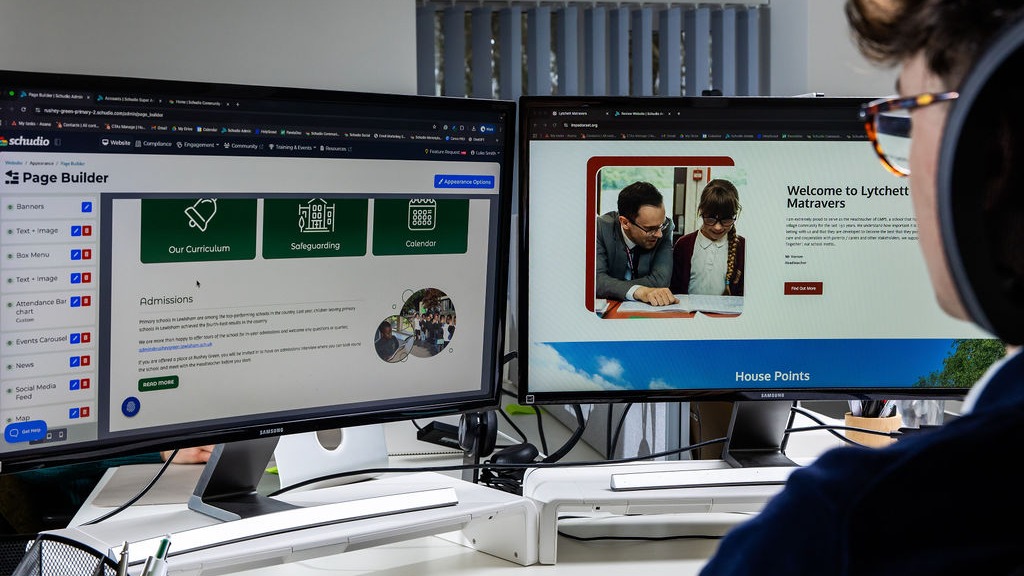
Only 6.5% of school websites we audited were fully compliant. A school website compliance checklist plus the year-round routine that keeps you always ready.
Ian Richardson
July 14, 2026
Publishing an allergy safety policy on your school website became a legal duty on 1 September 2026. What the law now requires, and what that date really means.

Ian Richardson
July 9, 2026
Your school website is the public front door to your school. It is where ..

Ian Richardson
June 1, 2026
School website policies are one of the most important parts of a school website, but ..

Ian Richardson
May 21, 2026
How Church schools can support SIAMS, Ofsted readiness and DfE website compliance through one clear ..