Using Your School Website to Reassure Parents Waiting for Places
Using Your School Website to Reassure Parents Waiting for Places
Most schools treat admissions as a season. Open evening in the autumn, an application deadline, then national offer day. The part that matters most to families is the bit in between, and it is long. A parent applying for a secondary place for September 2027 will apply by 31 October 2026 and hear on 1 March 2027. A parent applying for a primary school place will apply by 15 January 2027 and hear on 16 April 2027. Four months of waiting in one phase, three in the other.
For almost all of that time the family has no contact with you. No letter, no call, no meeting. Your only line of communication is your school website, and most schools barely use it.
The numbers say this matters to a lot of people. In the Department for Education figures published on 18 June 2026, covering entry in September 2026, 83.6% of secondary applicants and 92.4% of primary applicants were offered their first preference school. Put the other way round, roughly one in six secondary households and one in thirteen primary ones did not get the school they wanted most. Almost everyone was offered something they had ranked, 96.4% at secondary and 98.7% at primary, but an offer you ranked third is not the offer you hoped for.
So there are two waits. The wait before offer day, when a family is hoping. And the wait after it, when a child is on a waiting list, an appeal is being prepared, or a parent is trying to make peace with a school they did not choose. Your site is the only communication channel you control that speaks to both, and this post sets out how schools use it well.
The waiting period is longer than most schools realise
From inside a school the admissions process feels like a handful of busy weeks. From outside it feels like a very quiet half of the year, and it runs differently for primary schools, for secondary schools, and for the families who apply outside the main round.
The main round wait in a primary school and a secondary school
For secondary schools the national closing day is 31 October and offers are released on 1 March. A parent who applies on the deadline waits seventeen weeks. Many apply in September, straight after they visit, which stretches it past five months. An academy trust may run its own arrangements, but the national dates still apply.
For a primary school, applications close on 15 January and offers land on 16 April. Thirteen weeks, covering the whole spring term. Parents who came to your open morning in November and applied in early January may hear nothing until after Easter, even though they are choosing where their child will start school. By then the school has done its visible work. The tour is finished, the prospectus is downloaded, the deadlines have gone. From the family’s side, nothing happens for a very long time.
The second wait, which begins on national offer day
Offer day is not the end of the story for a large minority. Some are on waiting lists at two or three schools. Some are preparing an appeal. Some accept a place they are unsure about and spend the summer worrying about whether they made the right call for their child’s education. This wait runs from March or April through to September, and for waiting lists it legally runs further. It is when a family is most open to changing their mind, and when most schools go quietest.
The families waiting outside the main round
There is a third group schools forget entirely. Parents who move house in February. Children arriving from abroad. A child leaving another school in difficult circumstances. The Code is explicit at paragraph 2.23 that a parent can apply for a place at any school, at any time, and many apply directly to the schools they want rather than waiting for a round. They often wait under real pressure, sometimes with a child out of school altogether. They have not been to your open evening and will not have met your teachers. They find you by searching, and they judge you on what they see in about ninety seconds.
What the DfE numbers say about who is waiting
The June 2026 figures show the scale of it.
- Secondary first preference rate: 83.6%, very slightly up from 83.5% in 2025.
- Primary first preference rate: 92.4%, slightly down from 92.6% in 2025 and the lowest since 2022.
- Preferred offer rate, meaning any school the family ranked: 96.4% at secondary and 98.7% at primary.
- Application volumes fell again, by 1.3% at secondary and 1.6% at primary.
Two things follow for schools. The pool of applicants is shrinking, which is the falling birth rate working through the system, covered in Falling School Rolls: Why Your School Website Matters More Than Ever. Every parent who wavers is harder to replace than five years ago. And even where nearly everybody gets a school they listed, a meaningful number spend spring and summer unsettled. They are not statistics to you. They are the parents at your gate in September, and their children are the pupils starting in your classrooms.

Why silence during the wait does real damage
Parents do not read an empty site as a school busy teaching. They read it as a school that has stopped. That is unfair to a great many schools, and completely predictable. Think what a family has to go on. They came once, for an hour, and met you at your best. Since then, nothing. So they check online. If the latest news item is from last October, the fair conclusion is that not much has happened since October. If the staff list still names a head who left two years ago, the fair conclusion is that nobody is looking after the details.
None of that is what you meant to say. It is what you said anyway. We covered the mechanics in What Parents Actually Notice on a School Website: parents notice currency before design.
The wait is also when parents compare schools. Anyone who applied to three schools will check all three sites repeatedly between November and March. If two are alive and one is not, that comparison is being made whether you take part or not.
What prospective families actually do online while they wait
The behaviour is consistent. They re-read the admissions page. They look at news and photographs, the only way to see what an ordinary day at your school looks like. They look for term dates, uniform costs, and someone to contact when a question occurs at nine o’clock at night. Almost none of that is prospectus work, and most schools treat it as an afterthought. Good admissions communication is mostly answering those questions before they are asked.
The seven things a waiting family needs to find
Get these seven right.
1. A clear and current admissions process page
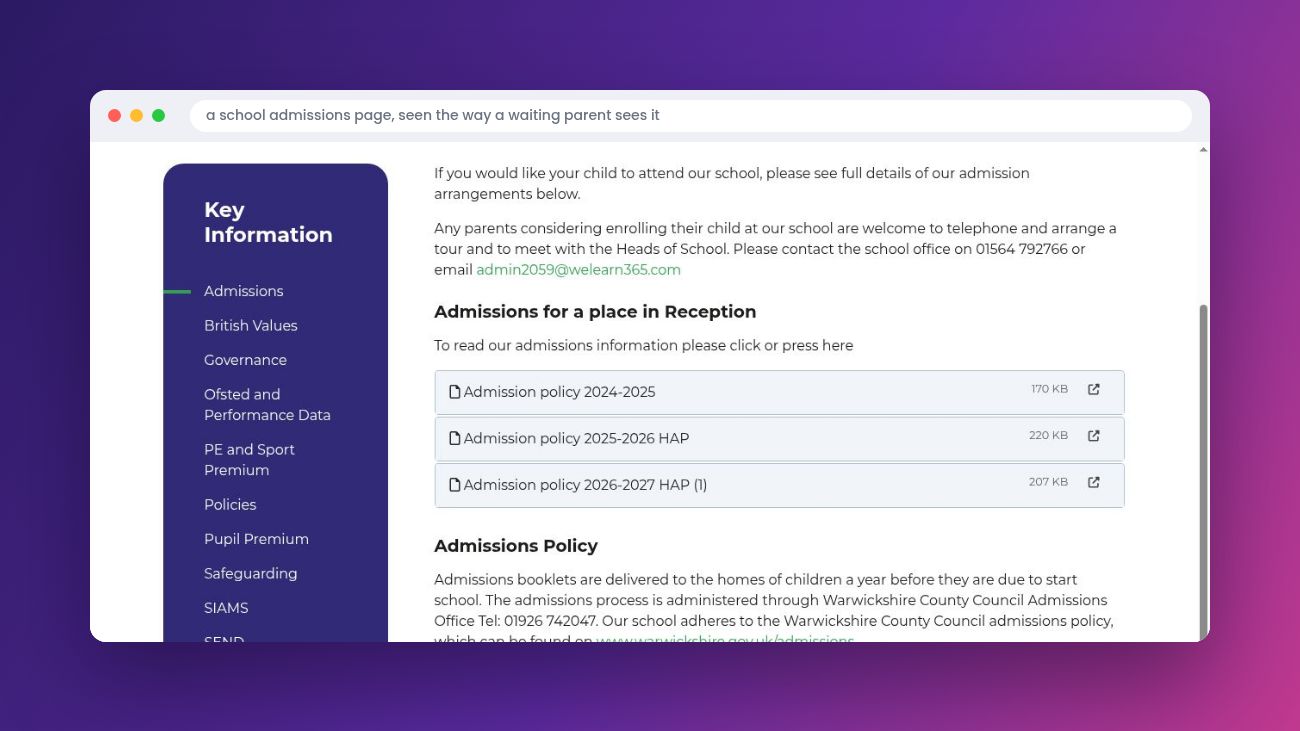
One page, in plain English, saying who the admission authority is, how to apply, what the deadlines are and what happens afterwards. Put the timings for the current round in words, not only inside a downloaded policy. Nobody should open a PDF to find out when they will hear. Say whether people apply directly to you or through the council, and link straight to the right page if it is the local authority. Getting this wrong is the most common cause of a phone call to your office.
2. Honest information about a school place and oversubscription
Publish your published admission number and your oversubscription criteria, each explained in a sentence. Then, if you can, say how last year went. For example, “we had 90 places and 137 applications, and the last place went to a child living 1.2 miles away” beats three pages of policy. Say plainly whether you use a catchment area or straight line distance, because people routinely assume one when you use the other. Schools worry this looks discouraging. It does the opposite.
3. Named contact details for your admissions team
A generic office inbox is not enough during a wait. Give a name, a role, a direct email, a phone number and the hours that person is available. If your admissions team is one person who also runs reception, say that too. They want to know who they are talking to.
4. Visible school life from this term
Covered in full below. A steady drip of ordinary news is the clearest evidence that yours is a real, warm school.
5. SEND and pastoral support
Parents of children with additional needs or disabilities read the most and worry the most. Make your SEND information report easy to find, name your SENDCo, and describe the support that is actually available rather than restating the law. Say how you settle a nervous child in, how you support a child who has to start school mid year, and what pastoral support looks like day to day. In secondary schools, say how you support students through transition and into sixth form choices. This is the biggest reassurance you can offer the people who need it most.
6. Practical detail for the first day
Uniform and where to buy it, with prices. Term dates. Transport and drop off. Lunchtimes. Wraparound care and what it costs. These are the questions a parent asks in bed at night, and answering them online saves your office a great deal of time.
7. What happens next
A short “what happens after you apply” section carrying the offer day, and the words “you will not hear from us before then” if that is true. People are far more patient when they know they are meant to be waiting. Most of the anxiety here is not the wait, it is not knowing whether it is normal.
Publishing school life is the reassurance
Everything above is structural. It goes up once and gets checked. The part that carries a family through three or four months is news. You do not need a communications team, you need a rhythm. One or two short items every week, published on your site first, is enough. We set out a workable cadence in How Often Should School Website News Be Published?
Between November and April the items that reassure most are the plain ones. A Year 4 trip. A maths challenge result. Older students running revision for younger year groups. Teachers setting up the hall for a concert. Pupils raising money for a local charity. None of it is remarkable, and that is the point. It tells a parent that ordinary days here look pleasant, and it builds confidence in a way no prospectus can.
Publish to your own site first and push out to social from there, so the site stays the record rather than the leftovers. And date everything visibly, because an undated item tells a parent nothing about whether you are active today.
How to write school admissions communication that sounds like a person
Plenty of schools have the right information up and still leave people cold. Admissions copy drifts into the language of policy. Three habits fix most of it.
Name the person. “Contact the school office” is a wall. “Email Sarah Whitfield, our admissions officer, at ad********@***********rg.uk, or call her Monday to Thursday mornings” is a door.
Say what you do not know. If you cannot tell a family whether they will get a place, write that down. “We will not know how oversubscribed we are until after the closing date, and we cannot give an indication before offers are released” is honest, and it stops them ringing to ask.
Cut the jargon, keep the terms that matter. Parents do need a few words, like oversubscription criteria and preference. Use them, then explain them. Drop the ones they do not need, like “the relevant determination year”.
Read your admissions page aloud. If it sounds like something you would never say at the gate, rewrite it. Communication here is not a marketing exercise. It is the same warmth you would show in person, written down, and the beginning of a relationship that may last seven years.
Reassuring the families who did not get a place
This is the half of the waiting period most schools ignore, and where clear information is worth most. What follows comes straight from the statutory codes.
Waiting lists: what the Code actually requires
Under paragraph 2.15 of the School Admissions Code 2021, every admission authority must maintain a clear, fair and objective waiting list until at least 31 December of the school year of admission. Two details are almost never explained. The list is re-ranked every time a child is added, in accordance with the published oversubscription criteria. And priority must not be given based on when the application was received or the name went on the list, so being on it longer does not move a child up, and a family joining in August can go above one that joined in March.
Many parents assume a queue. Say plainly that it is not, and you will spare people months of false hope. Also say how to join the list, whether they need to re-confirm, and who to contact for a current position.
Appeals: the timescales parents are entitled to
If you refuse a place, the Code requires you to give the reason and set out the right to appeal. The School Admission Appeals Code 2022 then sets the clock.
- Parents must have at least 20 school days from notification to lodge a written appeal.
- Appeals in the normal admissions round, lodged by the deadline, must be heard within 40 school days of that deadline.
- In-year appeals must be heard within 30 school days of being lodged.
Publishing those timescales is not an invitation to appeal. It is basic fairness, and it heads off any impression the process is deliberately vague. Say who administers appeals for your school, because for many schools and academy trusts it is the local authority.
Infant class size appeals work differently
This is essential for primary schools to explain, because it causes a great deal of misplaced hope. Infant classes, where most children reach the age of 5, 6 or 7 during the year, are limited by law to 30 pupils per school teacher.
Where a place is refused because admitting another child would breach that limit, section 4 of the Appeals Code applies and a panel can only uphold the appeal on narrow grounds: that admission would not actually breach the limit, that the arrangements did not comply with admissions law or were not applied correctly and the child would otherwise have had a place, or that the refusal was not one a reasonable admission authority would have made. A sentence explaining that is kinder than letting a family put months of hope into an appeal that was never likely to succeed.
In-year applications and families moving mid year
Paragraph 2.30 says the admission authority, or the local authority where it coordinates, should aim to notify parents of the outcome of an in year application in writing within 10 school days, and must do so within 15. Where a place is refused, the reason and the right to appeal must be included.
The same paragraph says parents must not be refused the opportunity to apply, or told they can only go on a waiting list instead of applying properly. Where a child is placed through the local Fair Access Protocol, paragraph 3.21 requires a place within 20 school days. An in-year page stating your process and those timescales costs nothing, and very few schools have one.
What your admissions pages must publish by law
Alongside the reassurance there is a hard requirement, and it catches schools out every year. Paragraph 1.49 requires every admission authority to determine its admission arrangements, including its published admission number, every year, even when nothing has changed, by 28 February in the determination year. Paragraph 1.50 then requires those arrangements to be published on the school website by 15 March, and kept on display for the whole offer year, meaning the year in which offers are made. That duty applies to an academy and to maintained schools alike.
Our own audit data shows how often it slips. In the State of School Website Compliance 2025 report, drawn from 247 audits across the year, admissions failed in 34.2%. Usually it is not a school ignoring the rules. It is an arrangements document that quietly went out of date, or a page still showing last year’s timings in May. Our School Website Requirements Guide covers the full picture, and the detail is in School Admissions Code and What to Publish on Your School Website.
Work closely with your local authority and be clear about who does what
Much of what a waiting family experiences is not in your hands. Local authorities must publish their coordinated admissions scheme by 1 January in the determination year, and their in-year information by 31 August. Offers on national offer day usually come from the council, not from you, and that is true for most academy schools as well as maintained ones. That split confuses people constantly. A parent will ring to ask why they have had no offer letter when it is coming from the local authority. Say who does what in one short paragraph and link out. Two sentences removes a whole category of phone call.
The same clarity helps when families compare you with independent schools, which run their own admissions process on their own timetable, with their own assessment arrangements and offer days. Anyone considering both is holding two calendars in their head. You need not comment on independent schools, you just need your own timings to be unmistakable.
A practical checklist for the waiting period
Work through this once and it holds for the year.
Before the deadline, September to January
- Admissions page states the process, the closing date and the offer day in plain text.
- Admission number, oversubscription criteria and distance measure stated clearly.
- Last year’s outcome summarised, if you can share it.
- A named admissions contact with email, phone and availability.
- Open events and tour bookings listed, and term dates published.
During the wait, November to April
- One or two news items a week, every week, dated and photographed.
- A short “what happens next” note on the admissions page.
- SEND report, pastoral support and uniform costs current and easy to find.
- Nothing advertising an event that has already happened.
- Staff list and leadership photographs accurate.
Around offer day, March and April
- A welcome post published on the day for those offered a place, with clear next steps.
- Waiting list information published, including that the list is re-ranked and time on it gives no priority.
- Appeals information published, with timescales, who administers them, and the infant class size position.
- In-year page current, with the 10 and 15 school day timescales stated.
By 15 March, every year
- Determined admission arrangements for the next round published, and the previous year’s kept up for the whole offer year.
- Diary reminder set for the same point next year.
Common mistakes to avoid
Treating the site as a campaign asset. Schools tidy up before open evening and let things drift afterwards, which is precisely backwards. Everything online carries the four months after it.
Letting the news stop at Christmas. The quietest period on most school websites is January to March, exactly when secondary applicants are waiting and primary applicants have just applied. Schools that keep publishing through that window stand out simply by carrying on.
Saying nothing to the families you turned down. A school with no waiting list or appeals information looks like one hoping those parents go away. Publishing the rules is confidence, not weakness.
Explaining the waiting list as a queue. It is not one, the Code says it is not one, and letting people believe otherwise causes real distress later.
Forgetting in-year families. They are under the most pressure and least likely to have met you.
Being vague to seem kind. Woolly language reads as evasion. Parents would rather hear “it is likely to be very tight this year”.

How this fits an Always Ready approach
None of this works as a burst of effort in February. The point of an Always Ready site is that it is in good order all year round, so there is never a scramble and never a gap. It is how the best schools we work with operate. The structural pages get checked termly and the news keeps running whatever the season. 15 March sits in someone’s calendar rather than someone’s memory. The waiting list and appeals pages are written once and reviewed each year, rather than rewritten in a panic when a parent complains.
Schools that work this way do not have an admissions problem to solve. They have a site that is simply current, and admissions benefits along with everything else, including your standing in the local community. That applies as much to a two form entry primary school as to an academy trust running secondary schools across a county. The schools that struggle are rarely the ones with the worst provision. They are the ones nobody can see.
If you are unsure how yours reads mid wait, that is worth a fresh pair of eyes. We look at school sites regularly and will tell you plainly what a waiting parent finds.


Frequently asked questions
When do parents hear about school places?
For entry in September 2027, secondary offers are released on 1 March 2027 following a 31 October 2026 deadline, and primary offers on 16 April 2027 following a 15 January 2027 deadline. Where a national offer day falls at a weekend, offers usually go out on the next working day. In-year applications have no national date.
How long must a waiting list be kept, and does time on it help?
Paragraph 2.15 of the School Admissions Code 2021 requires each admission authority to maintain one until at least 31 December of the school year of admission, and many schools run theirs longer. Time on the list gives no advantage: priority must not be given based on when an application was received or a name added, and the list is re-ranked against the published oversubscription criteria every time a child is added.
How quickly should a school respond to an in-year application?
Under paragraph 2.30 it should aim to notify parents in writing within 10 school days, and must do so within 15. A refusal must include the reason and information about the right to appeal.
How long do parents have to appeal, and when is the hearing?
At least 20 school days from notification to lodge a written appeal. Normal round appeals lodged by the deadline must be heard within 40 school days of that deadline, and in-year appeals within 30 school days of being lodged.
Why are infant class size appeals so hard to win?
Because infant classes are limited by law to 30 pupils per school teacher, and where that is the reason for refusal a panel can only uphold the appeal on the narrow grounds in section 4 of the Appeals Code.
What must be on our site about admissions, and by when?
Admission arrangements must be determined by 28 February under paragraph 1.49, published on the school website by 15 March under paragraph 1.50, and kept on display for the whole offer year. That applies to an academy and to maintained schools alike.
We are a small school with no marketing staff. Where do we start?
Start with the admissions page, the named contact and the offer day, because those three answer most of what your office already fields. Then build a weekly news habit, however short. That is the beginning of it. One or two items is plenty, and consistency beats volume. Everything else follows across the school year.
The short version
Parents wait three or four months to hear about a school place, and many then spend a second stretch on a waiting list or preparing an appeal. Across all of it, your school website is the only voice you have. Keep the process clear, name a human being they can contact, publish the waiting list and appeals rules honestly, hit the 15 March duty, and keep ordinary school life visible. Do that and the wait stops feeling like silence. It starts feeling like a school that has its act together, which is exactly what a parent is trying to work out.

Related Posts
Ian Richardson
February 6, 2026
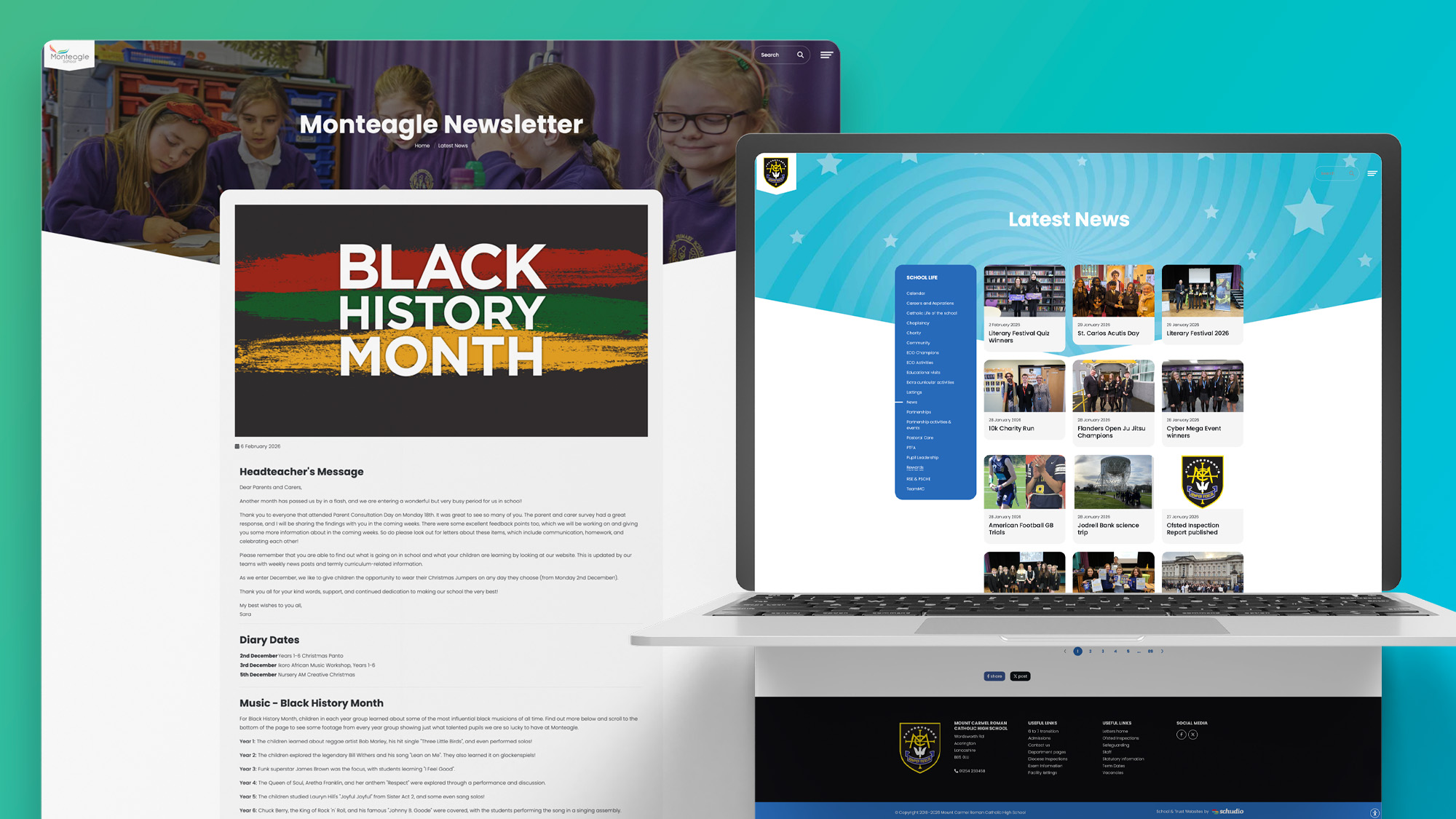
Most schools already produce some form of newsletter. What is changing is how those school ..
Ian Richardson
December 1, 2025
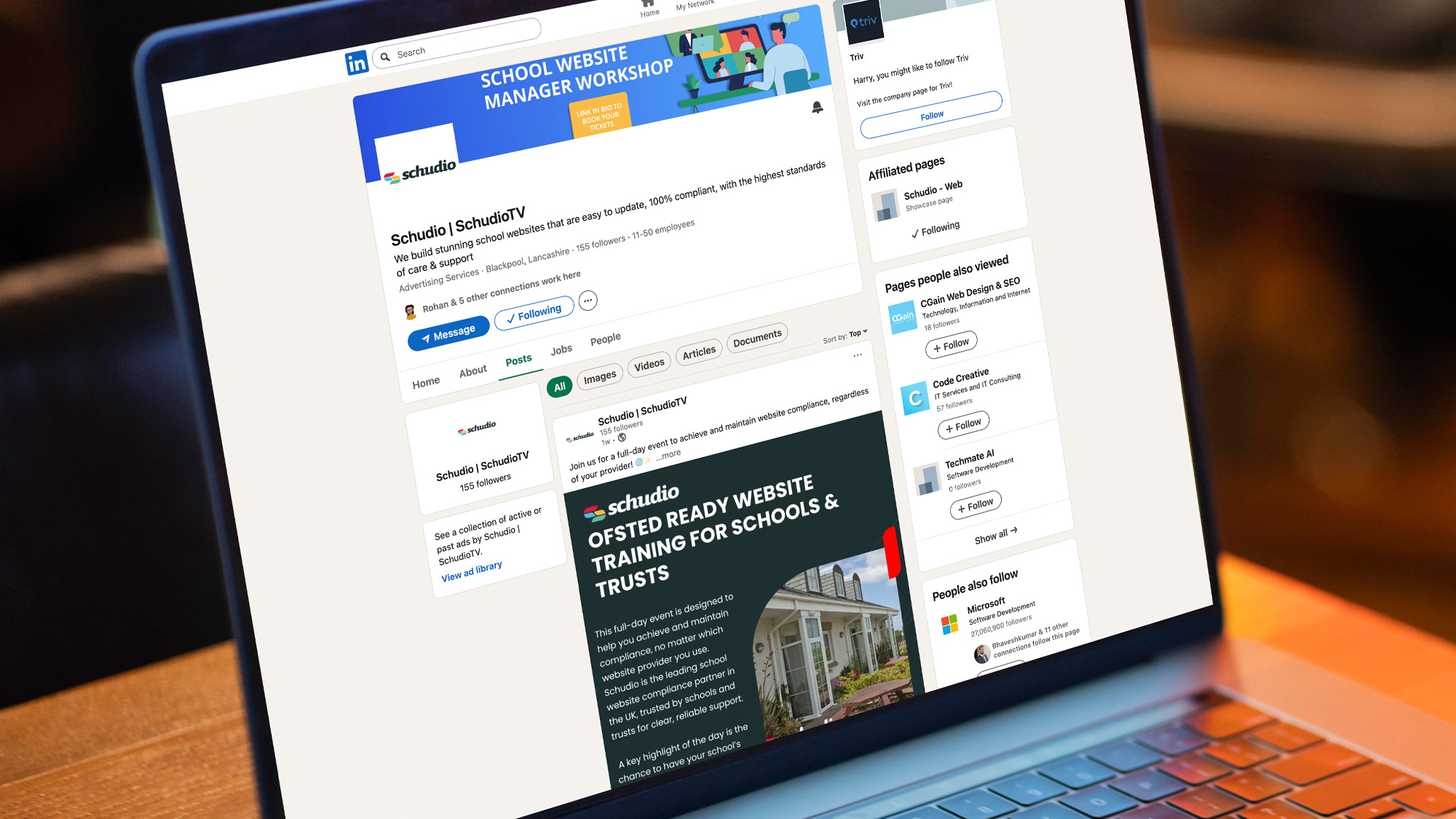
LinkedIn has become one of the most useful places for Trusts to share what they ..
Ian Richardson
September 19, 2025
We’re really excited to share something new that will make it easier for your school ..

Ian Richardson
July 28, 2025
Every now and then, a conversation with a school sums up exactly what so many ..

Ian Richardson
July 15, 2024
Summer is almost upon us, and with the end of the school year in sight, ..

Ian Richardson
January 30, 2024
Struggling to market your school without breaking the bank? Look no further. This no-nonsense article ..