School Allergy Policy: What Schools Need To Do, and What September 2026 Really Means
School Allergy Policy: What Schools Need To Do, and What September 2026 Really Means
Updated 8 September 2026. The legal position has changed since this post was last revised, and we have corrected it again. In July the duty to publish an allergy safety policy had not been commenced, and we said so plainly. It has since been commenced, with effect from 1 September 2026. If you read this post before today and took away that there was no September deadline, that is no longer right, and the corrected position is below. Getting this exactly right matters more to us than being consistent with what we said last month.
At a glance
- The Department for Education published new statutory guidance, “Allergy safety in schools”, on 6 July 2026.
- It says every school should have a written allergy safety policy, should publish it on the school website, and should review it at least once a year.
- Publishing the policy on your website is now a legal duty, from 1 September 2026. Section 34 of the Children’s Wellbeing and Schools Act 2026 was brought fully into force on that date by SI 2026/933, made on 17 August 2026, inserting section 100A into the Children and Families Act 2014.
- The guidance itself names no start date, which is why this was widely misreported through the summer. The branded school uniform limit starts on the same 1 September 2026 date, which added to the confusion.
- It applies to maintained schools (but not maintained nursery schools), pupil referral units, and academies including free schools and alternative provision academies (but not 16 to 19 academies).
- Our practical advice is unchanged, it is just no longer optional. Write the policy, publish it on your website, and put it in your annual review cycle.
Last reviewed: 8 September 2026. We will keep this post updated as the further regulations and duties are confirmed.
A school allergy policy is no longer just good practice. Statutory guidance sets out what it should say, your school website is where it has to live, and since 1 September 2026 publishing it there is a legal duty.
On 6 July 2026 the Department for Education published new statutory guidance called “Allergy safety in schools”. It sets out how schools should keep pupils with allergies safe. This post explains what the guidance says, exactly how firm each part of it is, what your allergy safety policy needs to cover, and the simple steps to get your website ready. We will update it as the remaining detail is confirmed.
What has changed, and what has not
For years, having an allergy policy was something schools were encouraged to do rather than required to do. That is beginning to change, and it is worth being precise about how far it has changed so far.
The new statutory guidance, “Allergy safety in schools”, was published on 6 July 2026. It flows from section 34 of the Children’s Wellbeing and Schools Act 2026, often called Benedict’s Law after Benedict Blythe, a five-year-old who died following an allergic reaction. Section 34 adds allergy safety to the existing duty to support pupils with medical conditions (section 100 of the Children and Families Act 2014).
Being statutory guidance matters. It means schools should follow it and be ready to give a clear and reasonable explanation if they ever depart from it. Inspectors will expect to see it in place.
Here is the part that was widely reported wrongly, including by us, so we want to be straight with you. The guidance itself sets no commencement date. It contains no reference to September and none to the 2026/27 academic year. On publishing, its words are that policies “should be published on the school, college or setting’s website” and made available in hard copy on request. Through the summer that was the whole of it, and the duty in section 34 of the Act had not been brought into force.
That changed on 1 September 2026, when SI 2026/933 brought section 34 fully into force. The resulting section 100A of the Children and Families Act 2014 makes publishing the policy on your website a legal duty, alongside having the policy and reviewing it at least annually.
One thing to watch, because it still trips people up. The guidance was published seven weeks before that commencement order and has not been updated, so it still says the Government “intends to introduce a statutory duty” to publish through forthcoming regulations. Read alone, that sounds like something yet to come. It is not. The publishing duty is in the Act and the Act is in force. The forthcoming regulations it means are the further requirements the Secretary of State can add, such as spare adrenaline devices and training.
So today, publishing your allergy safety policy is a must.
Where the September 2026 date came from
This is worth clearing up, because for most of the summer the September date belonged to something else entirely, and two separate changes ended up landing on the same day.
The first is uniform. Section 35, school uniform, was commenced on 1 September 2026, and from that date a school may not require more than three different branded items of uniform, or four for secondary and middle schools where one of them is a tie. Those regulations did not commence the allergy section, which is why anyone quoting a September allergy deadline in July was, at that point, quoting the wrong change.
The second is allergy, and it caught up. A later commencement order, SI 2026/933 made on 17 August 2026, brought section 34 into force on that same 1 September date. So the September deadline people were describing turned out to be real, just not for the reason they gave at the time.
Both policies therefore need attention. The uniform change alters what your uniform policy may require, and publishing that policy remains a should. The allergy change makes publishing your allergy safety policy a must.
Who the allergy guidance applies to
The guidance is statutory for the governing bodies of maintained schools including special schools, but excluding maintained nursery schools, for the management committees of pupil referral units, and for the proprietors of academies including free schools and alternative provision academies, but excluding 16 to 19 academies.
The Government has said it intends to introduce equivalent requirements for independent schools and non-maintained special schools, and early years settings should continue to apply the Statutory Framework for the Early Years Foundation Stage.
What the guidance asks schools to do
Here is the heart of it. Schools are expected to:
- Have a written allergy safety policy, publish it on the school website, and review it at least once a year.
- Give a named member of the senior leadership team responsibility for allergy safety. The guidance is clear this should not be left to the catering manager.
- Provide allergy and anaphylaxis training for all staff, so they can recognise an allergic reaction and respond in an emergency.
- Stock spare adrenaline auto-injectors for emergency use.
- Put an Individual Healthcare Plan in place for each pupil with allergies, and keep a record of every pupil with an allergy.
- Record serious incidents and near misses, and learn from them.
A quick word on how firm each part is, because the honest answer is that none of it is a commenced legal duty yet. All of the above sits in statutory guidance that schools should follow. The Government has said, repeatedly and in the guidance itself, that it intends to turn several of these into hard legal duties through regulations, including publishing the policy, naming a senior leader, training staff and holding spare adrenaline pens. In practice, the sensible move is to treat the whole list as your standard now, and not to wait to be told.
What your allergy safety policy should include
The guidance expects a dedicated allergy safety policy, not a couple of lines buried in a wider medical conditions policy. A good one sets out:
- Who in school has an allergy (pupils, and where relevant staff and visitors), what they are allergic to, and whether they carry medication such as an adrenaline pen.
- How you gather that information from parents and previous settings, including copies of any Individual Healthcare Plan or Allergy Action Plan.
- How you reduce risk day to day: school meals and catering (working with your school caterers on allergen information and cross-contamination), food brought in for birthday parties and special events, cooking classes, and school trips.
- Your emergency response: recognising anaphylaxis, giving adrenaline without delay, and calling 999.
- How spare adrenaline auto-injectors are stored, checked and used.
- Training for staff, and who is responsible for what.
- How you record incidents and review what happened.
Allergies can also count as a disability, so it is good practice to think about reasonable adjustments alongside the policy.
For the clinical detail, schools do not need to start from scratch. Allergy Action Plans from the British Society for Allergy and Clinical Immunology (BSACI), completed with a pupil’s healthcare professional, can form the basis of their Individual Healthcare Plan. Charities such as Allergy UK and Anaphylaxis UK also publish helpful resources.
Adrenaline auto-injectors, in plain terms
Adrenaline pens raise a lot of questions, so here is the simple version.
- Since October 2017, schools have been allowed to buy spare adrenaline auto-injectors without a prescription. The new guidance expects every school to hold them, and the Government intends to make that a legal duty through regulations.
- A spare pen is a back-up. Pupils prescribed their own should still carry two at all times.
- Store spare pens somewhere safe, central and easy to reach, clearly labelled, not locked away, and no more than a few minutes from where they might be needed.
- Anaphylaxis is time-critical. Give adrenaline without delay and call 999, even if a pen has already been used.
Why this matters for your school website
This is where it lands for us, and for you. The allergy safety policy is not an internal document. The guidance is clear that it should be published, and the school website is where parents, staff and inspectors will look for it.
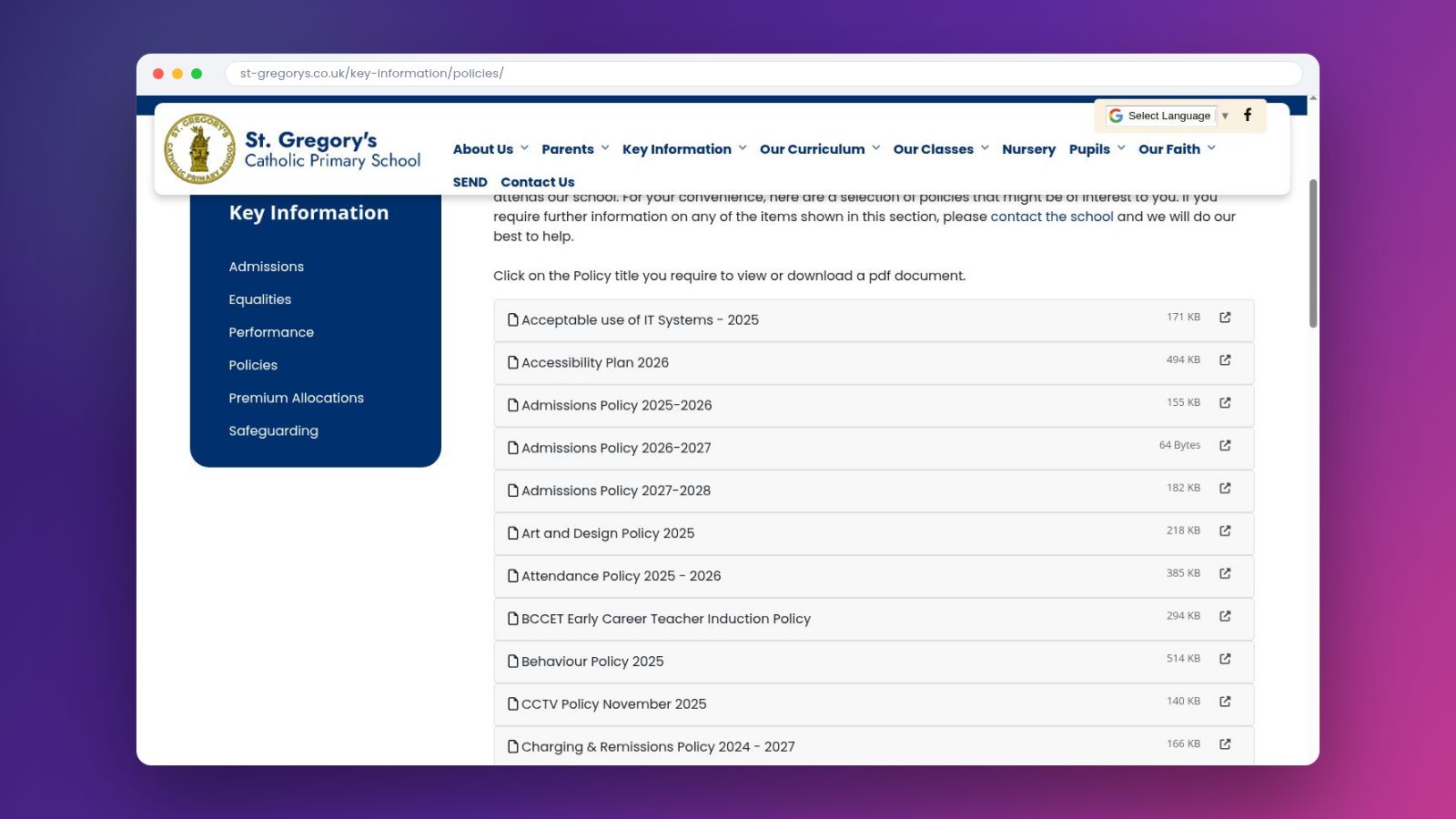
That puts it in the same family as your other statutory policies. And, as our own audit data keeps showing, the hard part is rarely publishing something once. It is keeping it current, keeping it easy to find, and making sure it does not quietly drift out of date. School website compliance is a maintenance job, not a one-off publishing job. An allergy safety policy is one more item that needs a clear home, a yearly check, and now a named person who owns it.
There is a human side too. A parent whose child has a serious allergy will look for your policy. Finding it, clearly written and easy to reach, is reassurance that your school takes their child’s safety seriously. No parent has ever checked whether a duty had been commenced before looking for it.
If you already keep your school website policies in good order, this will slot straight in.
The numbers behind the change
It helps to know why this is happening. The research is stark.
- Around 20% of food allergic reactions happen at school (Natasha Allergy Research Foundation).
- In a 2025 survey of almost 1,900 teachers, 67% had received no allergy awareness training, one in five had never been trained to use an adrenaline auto-injector, and 60% did not know whether their school had an allergy policy (NASUWT and the Natasha Allergy Research Foundation).
- About 8% of children in the UK have a food allergy, which is roughly two children in every classroom.
The new guidance is designed to close that gap, so that every school is ready rather than hoping it never happens.
How to get Always Ready, starting now
You do not need to wait for a commencement date. Here is a simple plan.
- Write or refresh your allergy safety policy so it reflects how your school actually works.
- Name a senior leader to own allergy safety.
- Give it a clear home on your website, alongside your other policies, so it is easy to find.
- Sort your spare adrenaline auto-injectors, their storage and their checks.
- Get Individual Healthcare Plans and Allergy Action Plans in place for pupils with allergies, and keep your record up to date.
- Book allergy and anaphylaxis training for all staff.
- Add the policy to your yearly review cycle, and risk assess trips, cooking classes and special events.
- While you are there, check your uniform policy against the new branded items limit that starts on 1 September 2026.
Keep it steady and joined up. This belongs in a calm, planned approach to your website and your safeguarding, not a last-minute scramble.
Get your whole website ready, not just the allergy policy
The allergy safety policy is one item on a longer list of things your website needs to get right. Two things will help you see the full picture.
- Download the free School Website Requirements Guide. It brings all the statutory requirements together with clear explanations and a full compliance checklist, and it is trusted by thousands of schools every year.
- Join our live school website compliance workshop. We walk through what your website needs, take your questions, and help you leave with a clear plan.
If you would like a hand getting ready, get in touch. We are always happy to help.
Frequently asked questions
Do schools have to have an allergy policy? Yes. Since 1 September 2026, section 100A of the Children and Families Act 2014 requires your arrangements for supporting pupils with medical conditions to include an allergy safety policy, and requires you to review it at least once a year. The statutory guidance of 6 July 2026 sets out what it should contain.
Is there a September 2026 deadline for the allergy policy? Yes, 1 September 2026, though not for the reason usually given. The guidance names no start date. The date comes from SI 2026/933, made on 17 August 2026, which brought section 34 of the Children’s Wellbeing and Schools Act 2026 fully into force on 1 September. Earlier in the summer the September date genuinely did belong only to the branded uniform limit, which is why this was so widely misreported, including in an earlier version of this post.
Do schools have to publish the allergy policy on their website? Yes. Section 100A(5)(c) of the Children and Families Act 2014 requires you to publish the policy on the school’s website. You must also make it generally known in school and to parents, and bring it to the attention of every pupil, parent and person who works at the school at least once a year, whether or not they are paid. The guidance adds that it should be available in hard copy on request. Note that neither DfE publish-online page mentions allergies yet, so you will not find this duty on the official lists.
Do schools have to keep spare adrenaline auto-injectors? The guidance expects every school to stock spare adrenaline auto-injectors for emergencies. Schools have been allowed to buy them without a prescription since 2017, and the Government intends to make holding them a legal duty through regulations.
Does every member of staff need allergy training? The guidance expects all staff to have allergy and anaphylaxis training so they can spot a reaction and respond. This is set to become a legal duty through regulations.
How often should the allergy safety policy be reviewed? At least once a year. Some schools choose to check theirs each term.
Who should be responsible for allergy safety in school? A named member of the senior leadership team. The guidance is clear it should not be left to the catering manager, and the Government intends to make a named senior leader a legal requirement.
What is an Individual Healthcare Plan? It is a plan for a pupil with a medical condition that sets out their allergens, the symptoms to watch for, the medication they need and what to do in an emergency. For a child with allergies, a BSACI Allergy Action Plan completed with their healthcare professional can form the basis of it.
This post reflects the position as at 8 September 2026. Sources: DfE statutory guidance “Allergy safety in schools”, published 6 July 2026; the Children’s Wellbeing and Schools Act 2026, sections 34 and 35; the Children’s Wellbeing and Schools Act 2026 (Commencement No. 3) (England) Regulations 2026, SI 2026/933, made 17 August 2026, which brought section 34 fully into force on 1 September 2026; and section 100A of the Children and Families Act 2014 as inserted by it. We will update it as the Government confirms the further regulations on spare adrenaline devices and training, and the extension to independent and non-maintained special schools expected from 2027.

Related Posts

Ian Richardson
August 25, 2026
The school website mistakes we find most often in compliance audits, what the rules actually say, and a practical checklist for fixing each one this term.
Ian Richardson
August 17, 2026
Only 6.5% of school websites we audited were fully compliant. A school website compliance checklist plus the year-round routine that keeps you always ready.
Ian Richardson
August 10, 2026
Only 6.5% of school websites we audited in 2025 were fully compliant. What our data shows, what changed for September 2026, and how to stay always ready.

Ian Richardson
July 9, 2026
Your school website is the public front door to your school. It is where ..

Ian Richardson
June 1, 2026
School website policies are one of the most important parts of a school website, but ..

Ian Richardson
May 21, 2026
How Church schools can support SIAMS, Ofsted readiness and DfE website compliance through one clear ..