The Most Common School Website Compliance Mistakes in 2026
The Most Common School Website Compliance Mistakes in 2026

Most school websites are not failing because nobody cares. They are failing on detail. The two Department for Education “what schools must publish online” pages have not changed since 24 October 2024, and only one new duty has arrived from elsewhere since, the allergy safety policy on 1 September 2026. What changes is the school. Staff move on, policies get reviewed, a document is replaced, a menu gets tidied, and six months later the website quietly no longer says what it should.
That is the pattern we see over and over. Across 247 website audits during 2025, covering 205 schools and 24 compliance areas, the average score was 80.2 per cent and the median 85 per cent. Only 16 audits came back fully compliant, which is 6.5 per cent. Nearly four in ten scored below 80 per cent. Almost every school is close. Very few are finished.
This post walks through the school website mistakes we find most often, what the rules actually say, and how to fix each one. If you want the underlying numbers, they are in our report on the state of school website compliance in 2026. This piece is about the mistakes behind those numbers.
The most common school website mistakes, in short
These are the common school website mistakes that come up again and again when we audit:
- Governance information that is incomplete or a year out of date
- PE and sport premium reports published late, or missing the swimming data
- Remote education information that was written in 2021 and never revisited
- Public sector equality duty statements and equality objectives that have expired
- SEND information reports that no longer describe what the school does
- Admissions information published late, or still showing last year
- Outdated policies, expired documents and staff who have left
- Accessibility issues that lock some parents out of key information
- Navigation problems that hide compliant content where nobody can find it
- School websites that fall apart on mobile devices, where most parents read them
Notice what is not on that list. Nothing here is a new rule or a technical failure. Every one is a maintenance problem.
Why so many schools fail on detail rather than effort
Compliance on school websites sits in an awkward place. It is nobody’s actual job. The business manager owns the finance information, the SENCO owns the SEN report, the head owns governance, and the person who can log in and change the website is often an administrator with twenty other things on. Nobody sees the whole.
It is also invisible when it works. A missing policy breaks nothing. Nothing turns red. The website still loads, the design still looks professional, and the only people who notice are an inspector, a parent making a complaint, or an auditor with a checklist.
Then there is timing. Many statutory requirements fall due at fixed points across the year. Miss one and you are non compliant for months without knowing.

What audit data says about the most common school website mistakes
The gap between what schools get right and what they miss is not random.
What most school websites get right
Failure rates were lowest for the Ofsted report at 1.9 per cent, ethos and values at 6.3 per cent, contact details at 11.7 per cent, safeguarding at 11.7 per cent and opening hours at 17.6 per cent. These are set once, rarely change, and a school wants to publish them anyway.
The areas most schools miss
Failure rates were highest for governance information at 49.8 per cent, PE and sport premium at 46.1 per cent, remote education at 42.1 per cent, public sector equality duty at 38.9 per cent, pay gap reporting at 37.3 per cent, SEND at 35.3 per cent, admissions at 34.2 per cent, results at 34.1 per cent, multi academy trust requirements at 32.7 per cent and curriculum at 31.8 per cent.
These all have something in common. Every one has to be refreshed on a cycle. Governance changes when a governor joins or leaves. The premium report and the results are annual. Equality objectives run on a four year cycle. The information decays, and unless somebody is watching, it decays quietly.
Mistake 1. Governance information that has drifted
Governance is the most missed area we audit, usually not because a school published nothing, but because what is published is a year behind.
Maintained schools must publish information about their governing body and its committees, in line with the constitution of governing bodies of maintained schools. DfE then recommends a longer list that inspectors and parents expect to see: the structure and remit of the governing body and its committees including the full names of their chairs, and for every governor who has served at any point in the past 12 months, their full name, appointment date, term of office, leaving date, who appointed them, and their attendance record over the last academic year. Governors’ business, financial and pecuniary interests should also be published, including governance roles elsewhere and interests arising from relationships between governors or between governors and staff.
Academy trusts carry parallel duties through the academy trust handbook, plus the requirement to publish the number of employees whose salary and benefits exceeded £100,000 in the previous academic year ended 31 August, in £10,000 bandings.
How to fix it
- Rebuild the table from the current register of interests, not last year’s version
- Include governors who left in the past 12 months, showing when they stepped down. Removing them entirely is the mistake
- Add attendance for the last academic year, not the current one
- Give the clerk a fixed review point each autumn term
Mistake 2. PE and sport premium reports that miss 31 July
Schools that receive PE and sport premium funding must publish, by 31 July each year, the amount received, a breakdown of how it has been or will be spent, the impact on pupils’ participation and attainment in PE and sport, and how that improvement will be sustained.
By the same deadline, they must publish the percentage of their year 6 cohort who can swim competently over at least 25 metres, use a range of strokes effectively, and perform safe self rescue in different water based situations.
Two things go wrong. The report goes up in the autumn term rather than by 31 July, so the website is non compliant right across the summer, exactly when prospective parents are looking. And the swimming percentages get left out, because they sit with a different member of staff.
The digital form trap
Here is a detail that catches many schools. If a school downloads its digital form return and uses that as the published report, it must convert the form to HTML. DfE says so explicitly, and the reason is accessibility. Uploading the raw download as a PDF is not enough. It is one of the most common mistakes schools make without knowing.
Mistake 3. Remote education information that stopped in 2021
Schools should publish information about their remote education provision. It is a should rather than a must, which is why it slips, and 42.1 per cent of the school websites we audited failed on it.
The usual finding is content written during lockdown, still referring to bubbles, national closure and a platform the school abandoned years ago. That is worse than nothing, because it tells a parent nobody has looked at the website in five years. Create a short, current statement instead: what happens if a pupil continues learning at home, which platform you use now, how work is set, and who to contact.
Mistake 4. Equality duty statements that quietly expire
Schools must publish how they comply with the public sector equality duty, updating this yearly, and their equality objectives, at least every four years. Both deadlines matter and both get missed.
The most common error is a set of equality objectives that expired two or three years ago, next to a compliance statement nobody has touched since. A reader cannot tell whether the school reviewed its duty and decided nothing needed changing, or simply forgot. Show when it was last reviewed.
Separately, schools with 250 or more employees must report gender pay gap information to the government and publish it prominently within one year of the snapshot date, which for most public authority employers is 31 March. Smaller schools need not comply, but DfE says they should seriously consider it.
Mistake 5. SEND information reports that no longer match the school
Schools must publish an SEN information report, updated annually, with changes reflected as soon as possible. To comply with section 69 of the Children and Families Act 2014 it must contain the information set out in Schedule 1 to the Special Educational Needs and Disability Regulations 2014, plus the arrangements for admitting disabled pupils, the steps taken to prevent them being treated less favourably, the facilities that help them access the school, and the accessibility plan.
Mainstream schools must also publish the name and contact details of their special educational needs co-ordinator. When a SENCO changes and the website does not, a parent trying to get help contacts somebody who left last year. A small mistake with a real cost.
The accessibility plan is the piece most often missing altogether. It is a separate document setting out how, over time, the school will increase the extent to which disabled pupils participate in the curriculum, improve the physical environment, and improve how they access information.
Mistake 6. Admissions information published late or for the wrong year
Admissions carries the tightest deadlines, and 34.2 per cent of audits found problems here.
Foundation and voluntary aided schools, and academy trusts, must publish by 15 March each year the admission arrangements for children starting at the normal point of entry the following September, and keep them up for the whole academic year in which offers are made. By 31 August, how in year applications will be managed. By 28 February, the appeals timetable, giving a parent at least 20 school days to lodge an appeal and 10 school days’ notice of the hearing.
Community and voluntary controlled schools must link to the local authority’s website for admissions and appeals.
The classic mistake is leaving last year’s arrangements up beyond 15 March, so two sets sit side by side and a parent cannot tell which applies. Archive the old set the day you publish the new.

Mistake 7. Outdated policies, expired documents and old staff details
This is the mistake schools recognise instantly. A policy with a review date of 2022. A weekly newsletter archive stopping mid year. A named safeguarding lead who left at Christmas.
The former headteacher problem
We regularly audit school websites where a former headteacher is still pictured on the welcome section, or named in the contact details, months after they left. The photo sat in a slider nobody thought of as content, and the name sat in a footer that appears everywhere at once, so nobody owned it. Every school must publish its postal address, telephone number, and the name of the member of staff who deals with queries from parents, carers and the public. If that name is wrong, an important requirement is failing.
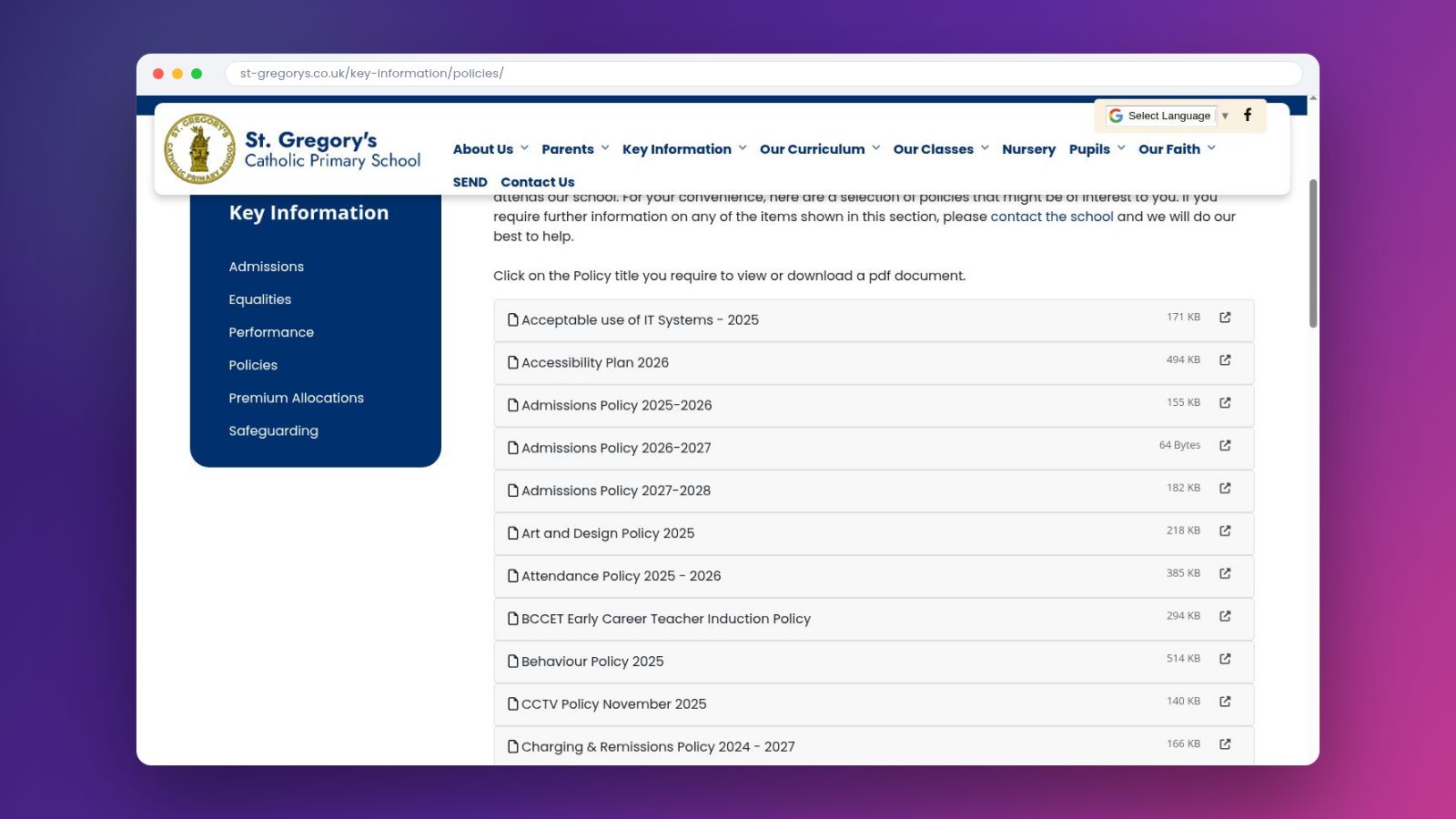
Clearing outdated policies quickly
- Sort your document library by upload date, oldest first, and start at the top
- Check the review point printed inside each policy, not when it was uploaded
- Use the search function to find the names of staff who have left in the last two years
- Check footers, sliders, banners and sidebars, which sit outside normal editing
- Delete rather than hide. A superseded policy still reachable by a search engine is still published
- Read the website copy while you are there. Typos and grammatical mistakes are the fastest way to look careless
Mistake 8. Accessibility issues that keep parents out
There is a lot of confusion here, so it is worth being precise. Under the Public Sector Bodies (Websites and Mobile Applications) (No. 2) Accessibility Regulations 2018, schools and nurseries are exempt except for content relating to essential online administrative functions. The common claim that every school website must meet WCAG level AA under those regulations is not accurate.
What does apply is the Equality Act 2010: the duty to make reasonable adjustments, the public sector equality duty, and the accessibility plan. Accessibility is not optional. The legal route is simply different from the one most articles quote.
In practice the accessibility issues we find on school websites are mundane and fixable:
- Key information locked inside scanned PDFs that a screen reader cannot access, so it is not accessible at all
- Images carrying important text with no alternative text, so the content is invisible to some users. Every one of your images needs a real description
- Poor colour contrast on buttons and headings, usually from a redesign
- Documents never converted to HTML, including the PE premium return
- Videos with no captions, which shuts out anyone watching without sound
- Link text that says “click here” rather than describing where the link goes
None need a developer. They are content habits, and once the habit changes school websites stay accessible without further work.
Mistake 9. Navigation problems and poor user experience
This one frustrates schools most. The information is there, written, approved and uploaded. Visitors just cannot navigate to it.
Poor navigation is not cosmetic, and it is where a tidy looking site can still fail. If a parent cannot reasonably locate the SEN information report, the school has arguably not published it in any meaningful sense. Inspectors and auditors behave like parents. They look for two minutes and form a view.
Common errors in menus and labelling
- Burying statutory requirements three or four clicks deep under a vague menu
- Using internal language. Schools write “Statutory Information” where a parent looks for “Policies”, “SEND” or “Term dates”
- Splitting one topic across several places so nothing answers the question in full
- Duplicate content left from an old structure, each copy holding a different version of the same policy
- A search function that returns nothing useful, or no search at all
A good test costs nothing. Ask somebody outside the school to find five things: the admission arrangements, the SEN information report, the year 4 curriculum, the complaints policy, and who to contact about safeguarding. Watch where they hesitate. That is your list. If visitors cannot easily navigate to statutory content, the user experience is a compliance problem, not just a design one.
Mistake 10. School websites that break on mobile devices
Most parents visit school websites on a phone, often in a corridor or on the way to work. Older students access them the same way. Yet content is still written and reviewed on a desktop screen.
The result looks tidy in the office and awkward on mobile devices. Wide results tables running off the edge. PDFs in a viewer nobody can pinch and zoom. Contact details set as images rather than text, so a parent cannot tap to call. Pages loaded with large uncompressed images that crawl over a mobile connection, so the visitor gives up before anything has loaded.
A modern website should be fully responsive and automatically adapt to whatever screen it is loaded on. Check your five busiest pages on a few different devices every term. It takes ten minutes and catches what no desktop review will.
Common mistakes on trust and multi academy trust websites
Trusts add a layer, and 32.7 per cent of audits flagged trust requirement issues.
Academy trusts must publish their audited annual report and accounts by 31 January each year. From the academy trust handbook 2026, effective 1 October 2026, multi academy trusts must also publish a summary statement accompanying those accounts, by 31 January, outlining how funds are distributed across the schools in the trust. The first is due by 31 January 2027, so plan for it now rather than discovering it in the new year.
The most common trust level mistake is inconsistency. One school site has an excellent set of statutory pages and its neighbour, on the same template with the same central team, is missing three. The rules do not apply to the trust as a single entity. Every school website is judged on its own.
The second is assuming a link to the trust website satisfies a school level duty. Sometimes it does, sometimes not. Publish at school level and link up to the trust. If you run several school websites, a shared platform built for multi academy trusts makes it far easier to see all of them at once.
Two duties worth watching this year
Neither appears on the DfE publish online guidance yet, and both are frequently misreported, so here is the accurate position.
School uniform. The Children’s Wellbeing and Schools Act 2026 limits the number of compulsory branded items, and that provision commenced on 1 September 2026. The statutory guidance on the cost of school uniforms was updated on 6 July 2026. The website duty has not changed: schools whose pupils wear a uniform should publish an easily understandable policy covering optional and required items, seasonal items, which must be branded, and where second hand uniform is available. What has changed is what the policy must say, so your published version needs revising even though the publishing rule is the same.
Allergy safety. This one did become a legal must, and an earlier version of this post said otherwise. Statutory guidance published on 6 July 2026 says schools should publish their allergy policy, and section 34 of the Children’s Wellbeing and Schools Act 2026 was then brought fully into force on 1 September 2026 by SI 2026/933. The resulting section 100A of the Children and Families Act 2014 requires you to have an allergy safety policy, review it at least annually and publish it on your school website. The guidance predates the commencement order and still refers to duties arriving through future regulations, and neither DfE list mentions allergies, which is why this one is so widely misreported. If the policy is not on your site, that is a live legal gap.
Your school website compliance checklist
Work through this once a term and you will catch most problems before anybody else does. It is ordered by when things fall due, because that is how compliance fails.
Deadlines to hold in the calendar
- 28 February. Admission appeals timetable published
- 15 March. Admission arrangements for next September published, previous year archived
- 31 March. Gender pay gap snapshot, publish within one year, if you have 250 or more employees
- 31 July. PE and sport premium report and year 6 swimming percentages published
- 31 August. In year admissions arrangements published
- 31 December. Pupil premium strategy statement published in the DfE template
- 31 January. Academy trust audited annual report and accounts, and from 2027 the MAT funds distribution statement
- Annually. Public sector equality duty statement, SEN information report, accessibility plan, results, governance details
- Every four years at most. Equality objectives
The termly ten minute review
- Open the website on a phone and check the five pages parents use most
- Search for the name of anyone who has left since the last review
- Check staff and governor lists against the current register
- Open three policies at random and check the review point inside the document
- Click every link on your statutory information section and note the broken ones
- Ask somebody outside school to navigate to five key items, and time them
- Check contact details, including the named staff member for parent queries and the SENCO
- Confirm curriculum content is published for every subject and year group
- Check results and the compare school and college performance service link are current, and look at anything in a footer, banner or slider, because normal reviews miss it
If you want every requirement in one place, our school website requirements guide lists them all with the source for each, and there is a longer walkthrough in our post on how to complete a school website compliance audit step by step.
Common mistakes schools make when fixing it all at once
Finding the problems is the easy part. These are the common pitfalls that put schools back where they started within a year.
Treating it as a one off project
A big push before an inspection fixes the website for about a term. Every high failure area sits on a refresh cycle, so drift starts again the moment the project ends. This is why we argue for an always ready approach to website compliance rather than an alert driven one. Ready, not warned.
Fixing the content and not the process
Updating the governance table is a fix. Deciding the clerk updates it every September is a system. Only the second survives a staff change.
Publishing everything as a PDF
PDFs are convenient for whoever uploads them and harder for everyone else. Worse on mobile devices, worse for a search engine, worse for accessibility, and they hide the review point from anybody who does not open the file. Create web pages where you can, and keep the PDF for documents that need printing or signing.
Assuming a new design solved it
A redesign does not make school websites compliant, and sometimes makes things worse. Content gets migrated, sections get merged, and statutory requirements met on the old website quietly disappear. Audit after a redesign, not just before.
Leaving it with one person
If everything depends on one administrator who knows where things live, you have a single point of failure. Split it. Governance to the clerk, SEND to the SENCO, results and premium reporting to the business manager, curriculum to subject leads and teachers.

How to build a review rhythm that holds
The schools that stay compliant are not the ones with the most time. They are the ones who made the review small, regular and owned. Three things make the difference. A named owner per area rather than one owner for the whole website. A calendar carrying the statutory deadlines rather than a vague reminder. And school software quick enough that people actually use it, instead of emailing a document to somebody else and hoping. Our school website software lets whoever owns the content create and publish it themselves.
If you would rather not carry the checking, we run independent school website compliance reviews against all 24 areas and give you a prioritised list rather than a raw score. And if you want to work through the requirements with us live, our free website requirements walkthrough workshop covers them area by area with time for questions.

Frequently asked questions
Have the school website requirements changed in 2026?
Yes, one has. Since 1 September 2026 you must publish an allergy safety policy on your website, under section 100A of the Children and Families Act 2014, commenced by SI 2026/933. The two DfE guidance documents for maintained schools and for academies and FE colleges were both last updated on 24 October 2024 and neither mentions allergies, so you will not find it there. Two further things moved elsewhere. The academy trust handbook 2026 adds a MAT funds distribution statement from 31 January 2027, and the uniform rules changed on 1 September 2026, which affects what your policy says rather than whether you publish it.
What is the most commonly missed school website requirement?
Governance information. Just under half the audits we ran in 2025 found a problem, usually incomplete governor details, missing attendance records, or a register of business interests not refreshed for the current year.
Do school websites have to meet WCAG 2.2 level AA?
Not under the 2018 accessibility regulations, which exempt schools and nurseries except for content relating to essential online administrative functions. Equality Act 2010 duties do apply, including the accessibility plan, so accessibility still matters. WCAG remains the sensible standard to design to even where it is not compulsory.
How often should we review our school website for compliance?
Once a term for a short structured check, plus a full review once a year. Add the statutory deadlines to the school calendar separately, because those catch people out. If a parent or inspector cannot reasonably find something, you will be treated as not having published it, so check navigation as well as content.
Does any of this apply to sixth form students and colleges?
Yes, with differences. Academies and FE colleges have their own DfE guidance, and colleges must publish their annual report and audited financial statements by 31 January, keeping them available for two years. Where a secondary school has a sixth form, the 16 to 18 progress, attainment, retention and destination measures for those students must be published too. Current students and their parents read those pages.
Where to start
If your website has not been reviewed this year, do not start with a full audit. Start with the three areas that fail most often: governance, PE and sport premium, and remote education. Fix those, give each an owner and a deadline, and you have removed the bulk of the risk in an afternoon.
Then build the rhythm. Compliance on school websites is not work you finish, it is a habit you create and keep, and the schools that keep it are ready whenever anybody looks.

Related Posts
Ian Richardson
August 17, 2026
Only 6.5% of school websites we audited were fully compliant. A school website compliance checklist plus the year-round routine that keeps you always ready.
Ian Richardson
August 10, 2026
Only 6.5% of school websites we audited in 2025 were fully compliant. What our data shows, what changed for September 2026, and how to stay always ready.
Ian Richardson
July 14, 2026
Publishing an allergy safety policy on your school website became a legal duty on 1 September 2026. What the law now requires, and what that date really means.

Ian Richardson
July 9, 2026
Your school website is the public front door to your school. It is where ..

Ian Richardson
June 1, 2026
School website policies are one of the most important parts of a school website, but ..

Ian Richardson
May 21, 2026
How Church schools can support SIAMS, Ofsted readiness and DfE website compliance through one clear ..