School Website Policies: Best Practice for Keeping Statutory Information Clear, Current and Easy to Find
School Website Policies: Best Practice for Keeping Statutory Information Clear, Current and Easy to Find

School website policies are one of the most important parts of a school website, but they are also one of the easiest areas to let drift.
A school might start with a tidy policies page. Then, a new child protection policy is uploaded. An old behaviour policy stays live somewhere else. A complaints procedure is added to a different section. The SEN information report is updated but not linked from the SEND page. The school accessibility plan is saved in a long list of documents where parents may struggle to find it.
Over time, no one is completely sure which version is current.
That is when school website policies become more than an admin issue. They become a school website compliance issue.
Schools must publish specific information online, and the DfE guidance is clear that maintained schools, academies, free schools and academy trusts all have publication responsibilities. The exact requirements depend on the type of school, but the principle is the same: statutory information should be accurate, current and easy to find.
Why school website policies matter
School website policies are not just documents for inspectors.
They help parents, carers, staff, pupils, governors and the wider school community understand how the school works.
Well-managed school website policies help create consistency. They show how decisions are made, what the school expects, how concerns are handled and how pupils are supported.
They also build trust.
Parents should not have to search through confusing school downloads or old PDFs to understand how the school handles complaints, safeguarding concerns, admission arrangements or special educational needs.
The problem with school website policies
The problem is most commonly that policies build up over time.
We often see school website policies become difficult to manage because:
- there are duplicate versions across the school website
- old policies are still live
- review dates have passed
- files are named inconsistently
- documents do not open in a new tab
- policies are stored only as PDFs
- links are broken
- the page gives no explanation for parents
- no one knows who owns each policy
- trust policies and school policies are mixed together
- policy pages have not been reviewed for the current academic year
This is how compliance drift happens.
The school website can look complete, but once you open the documents, check the date, read the review cycle and follow the links, the gaps appear.
What schools must publish
The DfE sets out what maintained schools must publish online and what academy trusts, free schools and colleges must publish online.
For maintained schools, this includes different types of schools maintained by a local authority. That can include primary schools, secondary schools, maintained special schools, voluntary aided schools and voluntary controlled schools.
Academy trusts and free schools have their own publication guidance. Trusts need to make sure trust-level documents are clear, but individual academy schools still need to signpost the right information from the school website.
The details vary by school type, but schools must publish or signpost a wide range of information, including:
- contact details
- admission arrangements
- behaviour policy
- complaints procedure
- safeguarding information
- child protection policy
- curriculum information
- SEN information report
- public sector equality duty information
- school accessibility plan
- governance information
- financial information, where relevant
- pupil premium funding information, where relevant
- PE and sport premium information, where relevant
- careers information, where relevant
- performance information, where relevant
Some information is best shown directly on the webpage. Some can sit in a document. The key is that the required information is easy to find, current and accessible.
One source of truth for school website policies
One of the most important principles for school website policies is having one source of truth.
A policy can be linked from more than one place, but there should only be one current version.
For example, a safeguarding policy may need to be linked from:
- the safeguarding page
- the policies page
- the statutory information section
- a trust policy page
That is fine, but each link should point to the same current child protection policy.
If one version is updated and another is missed, the school website immediately creates confusion.
This is especially risky for safeguarding. If a current child protection policy appears in one place and an old one appears elsewhere, it can damage confidence very quickly.
A simple rule helps:
One policy. One current version. Clear links from relevant pages.
Make policy ownership clear
A school website manager can upload a document, but they may not know whether the policy itself is correct.
That is why every policy needs an owner.
For example:
- child protection policy: DSL or senior leader
- behaviour policy: headteacher or senior leader
- complaints procedure: headteacher, school business manager or trust lead
- SEN information report: SENCO
- admission arrangements: school, governing body, academy trust or local authority, depending on the school
- public sector equality duty information: senior leader or governing body
- school accessibility plan: senior leader, SEND lead or governing body
- pupil premium funding information: senior leader or finance lead
- PE and sport premium: PE lead or senior leader
- governance information: clerk, governance professional or governing body
The person who owns the content should confirm it is current.
The person who manages the school website should make sure it is published clearly.
That separation matters.
Use review dates properly
Every major policy should have a clear review cycle.
A policy may look professional, but if the review date has passed, it creates a problem.
For example, if a policy says it will be reviewed in March 2026 and it is still live unchanged in May 2026, the school has missed its own published date.
That does not always mean the policy content is wrong, but it does mean the public version looks unmanaged.
For school website policies, check:
- approval date
- last review date
- next review date
- version number, if used
- policy owner
- committee or governing body approval, where needed
Schools maintained by a local authority and academy trusts should have effective procedures for making sure website information remains accurate and up to date.
Group policies so people can find them
A long alphabetical list of school website policies is not always the easiest structure for parents.
It may be better to group school website policies by topic.
For example:
Safeguarding and wellbeing
- Child protection policy
- Safeguarding policy
- Anti-bullying policy
- Online safety policy
- Attendance policy
Behaviour and expectations
- Behaviour policy
- School uniforms policy or guidance
- Exclusions or suspensions policy
- Relationships education policy
- Sex education policy, where relevant
SEND and inclusion
- SEN information report
- SEND policy
- School accessibility plan
- Public sector equality duty information
- Equality objectives
Admissions and complaints
- Admission arrangements
- Admission appeals timetable
- Complaints procedure
- In-year admissions information
Curriculum and learning
- Curriculum policy or curriculum overview
- Music development plan
- Religious education information
- Reading schemes
- Relationships education information
- Technical education information, where relevant
Governance and finance
- Governance information
- Financial and pecuniary interests
- Pupil premium funding information
- PE and sport premium information
- Gender pay gap information, where relevant
- Audited annual report, where relevant
This structure helps parents and carers find the right information more quickly.
It also helps staff spot gaps.
Do not rely only on school downloads
School downloads are useful, but they should not carry the whole user journey.
For important areas, the webpage should explain the key points in plain English, then link to the document.
For example, a complaints page should explain how a parent or carer lodging a concern can start the process. It should then link to the full complaints procedure.
An admissions page should explain the process for the relevant age group, normal age group, in-year admissions and appeal arrangements. It should then link to the full admission arrangements, application form, supplementary information and local authority’s website where needed.
A SEND page should explain support clearly before linking to the SEN information report.
A safeguarding page should show who to contact and what to do if there is a concern, before linking to the child protection policy.
This is better for parents.
It is better for accessibility.
It is better for school website compliance.
Admission arrangements: key publication dates
Admission arrangements are a good example of why review dates matter.
By 15 March each year, maintained schools must publish admission arrangements for children starting school at the normal point of entry in September of the following year. That information should stay available for the whole academic year in which offers are made. Academy trusts have equivalent publication duties for admissions.
By 31 August each year, schools must publish how they will manage in-year applications, including whether the governing body, trust or local authority manages those applications.
Schools must publish a timetable for admission appeals by 28 February each year, explaining how they will organise and hear admission appeals.
This is exactly why school website policies and statutory pages need a calendar.
The date matters.
The policy matters.
The page around it matters.
Safeguarding and child protection policy
Safeguarding information should be clear, current and easy to find.
The child protection policy is one of the most important school website policies. It should be easy to access from the safeguarding page and from the policies area.
Schools should check:
- the child protection policy is current
- the review date has not passed
- the DSL information is correct
- the safeguarding page links to the right document
- there are no duplicate old versions
- related policies are grouped clearly
- information is written clearly for parents
Safeguarding information is often one of the first areas reviewed before or during inspection activity, so the public information needs to show that the school takes it seriously.
SEN information report and school accessibility plan
The SEN information report should be reviewed and published clearly.
This is not just a compliance document. It is a key page for families.
Parents should be able to understand:
- what special educational needs are supported
- who to contact
- how support is arranged
- how the school works with parents
- how pupils are involved
- how support is reviewed
- how disabled pupils access facilities and the curriculum
The school accessibility plan should sit clearly alongside SEND or inclusion information. It should explain how the school plans to improve disabled pupils access to the curriculum, pupils facilities, other pupils facilities where relevant, and information.
The wording should be clear enough for parents, not just written for compliance.
Public sector equality duty
Public sector equality duty information should not be hidden.
Schools should make equality objectives and related information easy to find from the school website.
This may sit alongside:
- equality information
- school accessibility plan
- SEND
- governance
- policies
- curriculum
- behaviour and inclusion
This is an area that can easily become out of date, especially if objectives were set several years ago and no one has scheduled a review.
Pupil premium and PE and sport premium
Schools that receive pupil premium funding need to publish pupil premium spending information and strategy statement content.
This should help parents and the wider community understand how the funding is being used to support disadvantaged pupils schools are responsible for, and how the school intends to measure impact.
Schools should make sure the strategy statement includes measurable outcomes and is updated for the correct academic year.
PE and sport premium information should show how sport premium funding is being used and what difference it is making. Many schools miss this because the page looks complete, but the document relates to the wrong year.
Governance, finance and pay information
Governance information needs careful management.
Schools should publish details about the governing body where required, including roles, responsibilities, body and committee meetings, attendance and financial and pecuniary interests.
Maintained schools and academy schools have different structures, but transparency is the shared principle.
Academy trusts should also review financial information, including audited annual report content and any required executive pay or gender pay gap information.
Most public authority employers with 250 or more employees need to publish gender pay gap data. This may affect larger academy trusts. Trusts may also choose to publish ethnicity pay gap information, if any, as part of wider transparency.
Where required, information about gross annual salary bands for senior staff should be easy to locate.
The important point is that governance and finance information should not be buried.
Visitors should not have to work hard to find it.
Curriculum, performance and learning information
Some school website policies and statutory pages sit close to curriculum.
Schools should make curriculum information clear, including national curriculum requirement areas, key stage information, religious education, relationships education, sex education and the music curriculum.
Where relevant, schools should publish a music development plan.
Primary schools should check whether they need to publish primary progress measures, maths progress measures, pupils average scaled score and related information. If the school cannot calculate primary progress measures or does not publish progress scores for a valid reason, it can help to explain this clearly.
Secondary schools should check their own performance measures page, including EBacc average point score where relevant, technical education information, careers information and published education outcomes.
The exact detail depends on the school type, but the principle is the same: publish easily accessible data and give parents enough context to understand it.
Make school website policies accessible
School website policies should meet accessibility requirements.
That means documents and pages should be usable by people with different needs.
Check:
- clear headings
- readable document names
- descriptive links
- accessible PDFs
- HTML content where possible
- alt text for meaningful images
- keyboard navigation
- screen reader support
- suitable colour contrast
- plain English summaries
- documents that open correctly on mobile
Where important information is locked away in inaccessible PDFs, the school website becomes harder for people to use.
Good accessibility is part of good policy management.
Use HTML where possible
PDFs are often necessary for formal school website policies, but they should not be the only format.
Use HTML on the school website for key summaries, signposting and parent-facing guidance.
This works especially well for:
- contact details
- admissions
- complaints
- safeguarding
- behaviour
- SEND
- equality
- accessibility
- curriculum
- school uniforms
HTML content is easier to read on mobile, easier to search, easier to update and often more accessible.
Keep file names clear
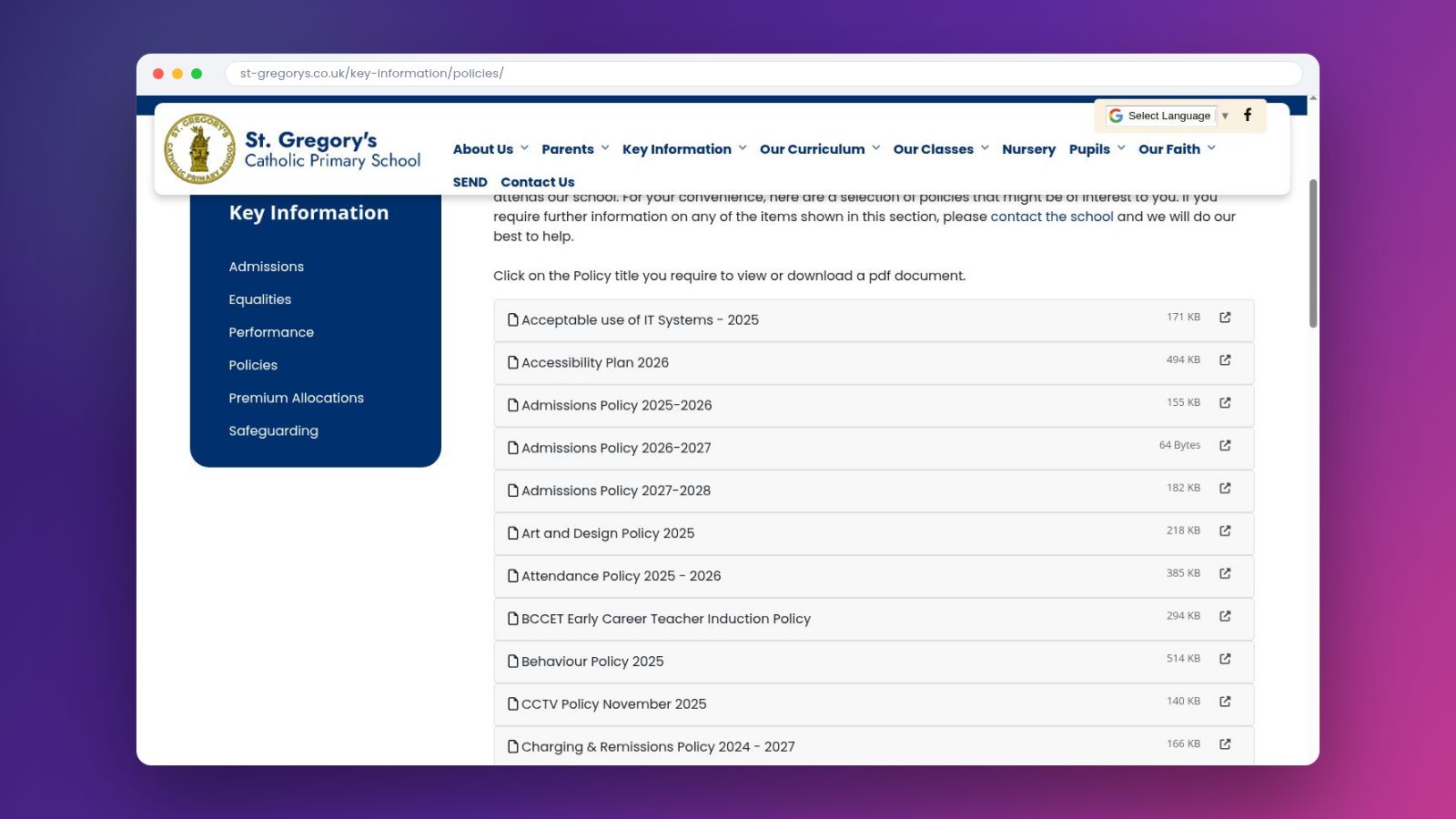
Policy file names should be simple and consistent.
Avoid names like:
- final-final-policy.pdf
- new-version.pdf
- behaviour-updated-copy.pdf
- policy-2026-v3-use-this-one.pdf
Use names like:
- Behaviour Policy 2026
- Child Protection Policy 2026
- Complaints Procedure 2026
- SEN Information Report 2026
- School Accessibility Plan 2026-2029
- Admission Arrangements 2026-2027
Clear names help staff, parents, governors and inspectors.
They also make the school website easier to search.
Remove old policies
Old policies cause confusion.
If an old policy is still live, a parent may find it through website search, Google search or an old link.
Schools should regularly check for:
- duplicate policy documents
- old admissions documents
- old safeguarding policies
- old complaints procedures
- old curriculum files
- old pupil premium documents
- old PE and sport premium statements
- old governance records
- outdated school downloads
A simple question helps:
Could someone accidentally find the wrong version?
If yes, remove or archive the old version properly.
Build a policy review calendar
School website policies need a review calendar.
The calendar should show:
- policy name
- policy owner
- approval route
- last review date
- next review date
- where it appears on the school website
- whether the policy is statutory
- whether it is school-level, trust-level or local authority content
A review calendar helps schools stop relying on memory.
It also helps when staff change.
The process should belong to the school, not just one person.
A simple school website policies checklist
Use this checklist as a starting point:
- Do we have one current version of each policy?
- Are any duplicate versions live?
- Are review dates current?
- Does each policy have an owner?
- Are statutory policies grouped clearly?
- Do parents understand where to find key information?
- Are safeguarding and child protection policy links clear?
- Is the complaints procedure easy to find?
- Are admission arrangements and appeal arrangements current?
- Is the SEN information report reviewed and easy to access?
- Is the school accessibility plan easy to find?
- Is public sector equality duty information current?
- Are pupil premium and PE and sport premium documents in date?
- Is governance information clear and complete?
- Are financial and pecuniary interests published where required?
- Are school downloads accessible?
- Are old files removed?
- Are policies written or introduced in plain English?
- Does the school website use HTML summaries where helpful?
- Is there a review calendar for the full academic year?
School website policies and parental confidence
Good policy management is not just about compliance.
It supports better communication with parents.
Clear school website policies help parents understand expectations, routes for support and how the school works.
They help with safeguarding confidence.
They help families understand admission arrangements.
They help parents know how to raise concerns.
They help the school community understand behaviour, attendance, SEND, equality and curriculum.
When policies are current and easy to find, the school website feels trustworthy.
When they are old, duplicated or difficult to use, confidence drops.
School website policies should support an Always Ready approach
School website policies should not be a last-minute job.
They should be part of an Always Ready approach to school website compliance.
That means:
- clear ownership
- one source of truth
- current review dates
- accessible documents
- useful page summaries
- no duplicate versions
- regular audits
- simple calendar reminders
- clear links from relevant pages
This is how schools avoid the stressful policy scramble.
Not panic.
Not a last-minute hunt through folders.
Just a steady, repeatable process that keeps school website policies under control.
Need help reviewing your school website policies?
A good place to start is a school website compliance audit.
It will help you check whether your school website policies are current, clearly organised, accessible and easy for families to find.
You can also join one of our monthly School Website Compliance Workshops, where we walk through the latest requirements, common issues and practical fixes for school websites.
Start small.
Pick one policy area.
Check the date.
Remove duplicates.
Confirm the owner.
Make the page easier to use.
Then build from there.

Related Posts

Ian Richardson
August 25, 2026
The school website mistakes we find most often in compliance audits, what the rules actually say, and a practical checklist for fixing each one this term.
Ian Richardson
August 17, 2026
Only 6.5% of school websites we audited were fully compliant. A school website compliance checklist plus the year-round routine that keeps you always ready.
Ian Richardson
August 10, 2026
Only 6.5% of school websites we audited in 2025 were fully compliant. What our data shows, what changed for September 2026, and how to stay always ready.
Ian Richardson
July 14, 2026
Publishing an allergy safety policy on your school website became a legal duty on 1 September 2026. What the law now requires, and what that date really means.
Ian Richardson
July 9, 2026
Your school website is the public front door to your school. It is where ..

Ian Richardson
May 21, 2026
How Church schools can support SIAMS, Ofsted readiness and DfE website compliance through one clear ..