How should schools publish staff profiles on their website for safeguarding?
How should schools publish staff profiles on their website for safeguarding?
This is a question I hear regularly when schools review their website.
Parents expect clarity. Inspectors expect transparency. Staff quite reasonably expect protection – and schools are often trying to balance all three at once.
When schools ask how should schools publish staff profiles on their website for safeguarding, the discussion quickly moves beyond layout or design. It becomes a safeguarding conversation, tied to child protection, online safety, and how schools manage risk in an online world that now touches almost every part of school life.
This article looks at that wider context and shares a real example of how one school addressed the issue in a way that felt sensible, proportionate, and workable for staff.
Why staff profiles matter on a school website
Staff profiles are consistently one of the most visited pages on a school website.
Families use them to:
- Understand who is teaching their child
- Put names to faces
- Feel confident about the adults working with children and young people
From a leadership point of view, staff pages support transparency and trust. They show structure, accountability, and professionalism across education settings, including primary schools, secondary schools, and independent schools.
In practice, removing staff profiles altogether tends to raise more questions than reassurance.
The safeguarding risks schools are trying to manage
Publishing staff information online does bring risks, and schools are right to think carefully about them.
Common concerns include:
- Public posts being taken out of context
- Images reused across social media platforms
- Increased exposure to online abuse
- Staff being contacted through personal accounts
- Personal information becoming easier to access through online searches
These risks sit within a much broader safeguarding picture that includes online behaviour, digital footprint, and a person’s online behaviour away from school.
Many schools now recognise that the online environment brings safeguarding responsibilities that simply did not exist in the same way ten years ago.
Staff photos, social media, and professional boundaries
One area that often causes the most hesitation is staff photographs.
Once an image is published online, it can be copied, shared, or saved. Combined with social media feeds, online gaming spaces, and wider online activity, this can blur professional boundaries if schools are not careful.
Good safeguarding practice relies on a clear separation between:
- Professional online presence
- Personal social media accounts
- Private information
- Public-facing school content
Most staff codes of conduct already set clear rules around personal accounts and contact with pupils. Website decisions should reinforce those boundaries, not undermine them.
A real safeguarding-led example from a primary school
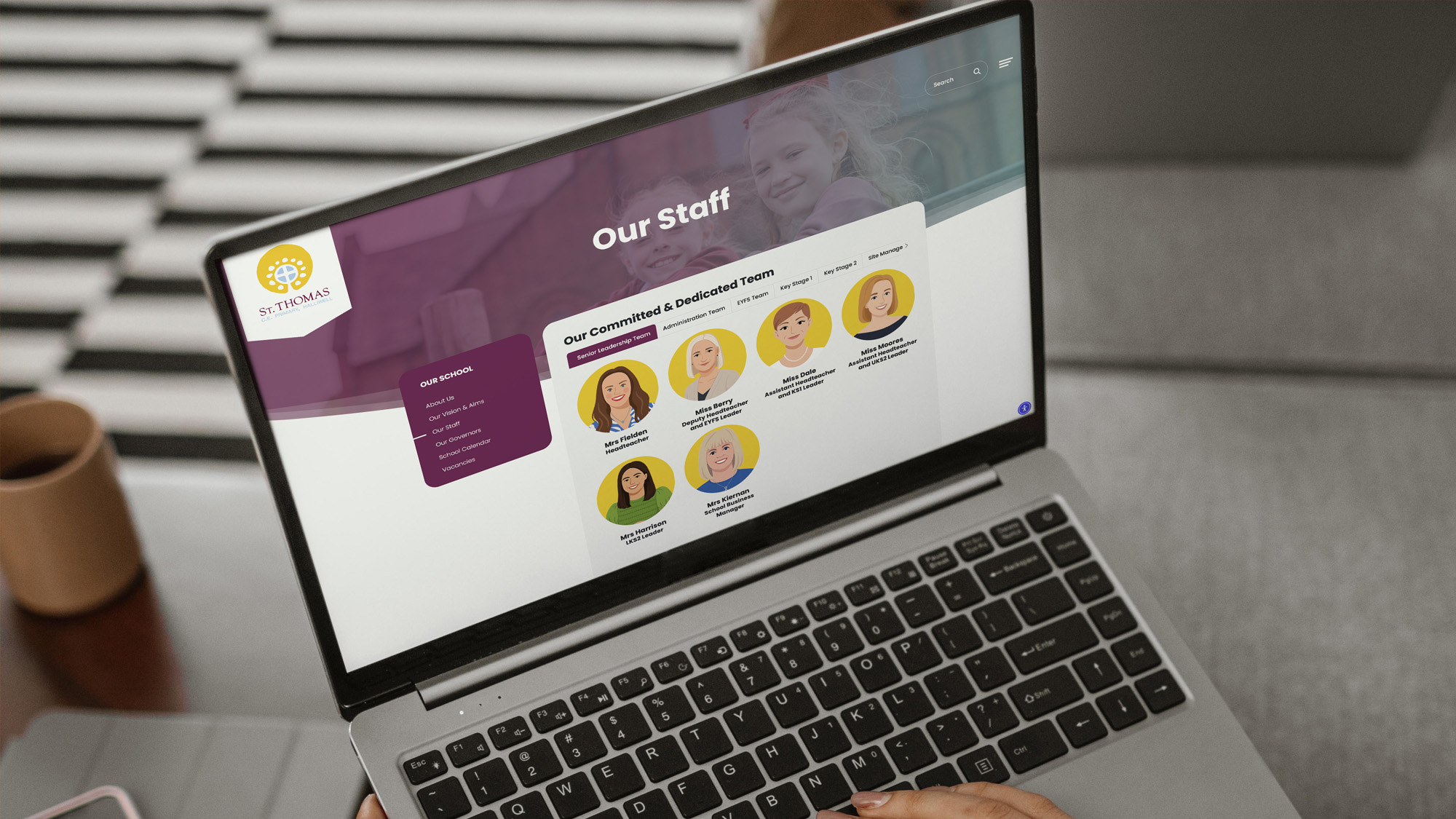
When St Thomas’ Halliwell C.E. Primary School reviewed their staff page, safeguarding was the starting point rather than an afterthought.
The school wanted:
- A welcoming staff page
- Clear names and roles
- Reduced exposure for staff members
- A safe environment for children
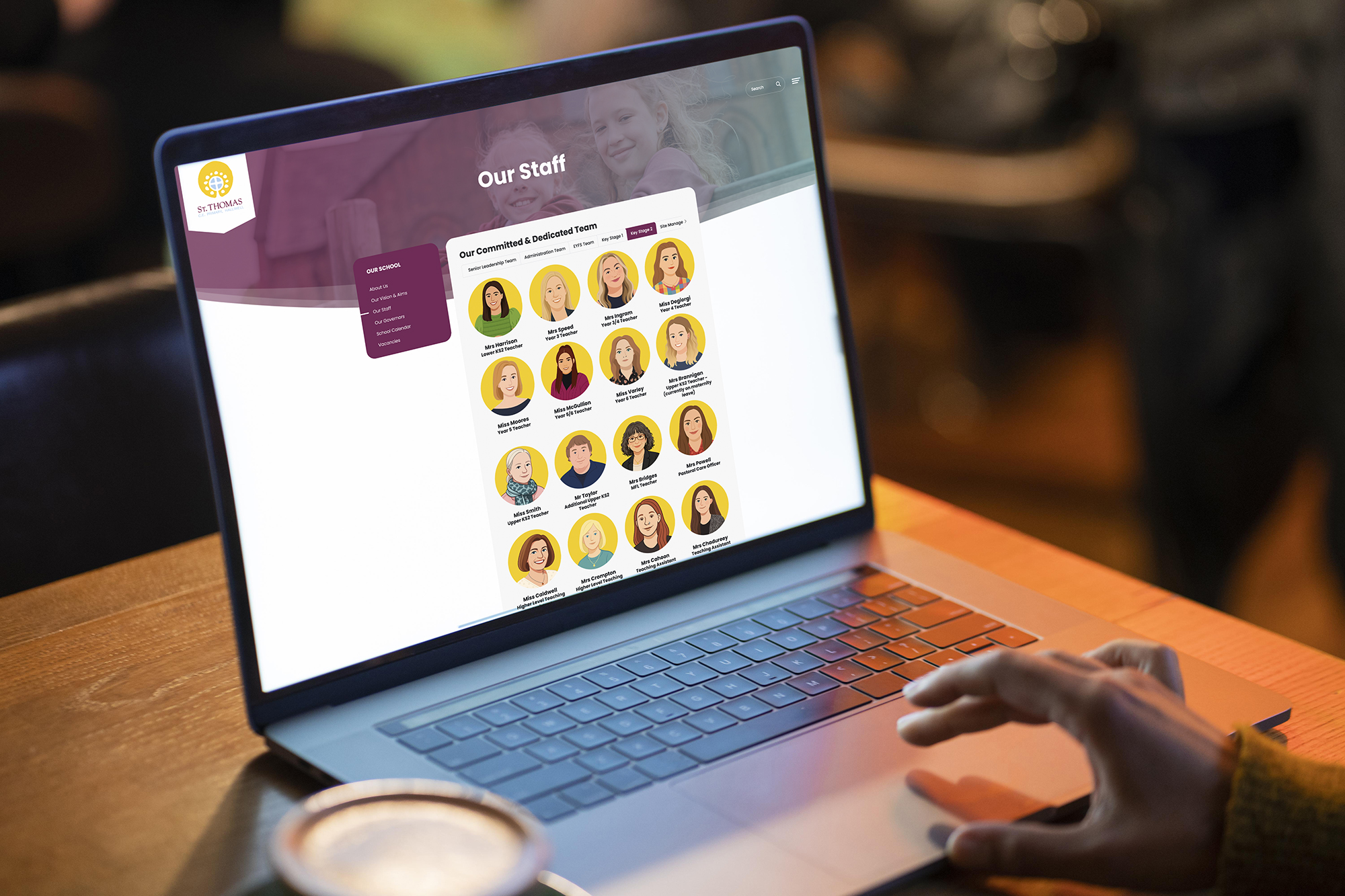
Rather than removing profiles or relying on traditional photos, the school chose to use illustrated staff portraits created with AI.
Each staff member uploaded a photo privately. An AI tool generated a graphic illustration from that image. The original photo never appeared online.
What parents see is a consistent, professional illustration linked clearly to each role. What mattered most here wasn’t the technology itself, but staff confidence. Once staff understood that their real photos would not be published, the conversation shifted quickly.
Why illustrated profiles support safeguarding
This approach works because it supports safeguarding in several ways at once.
Reduced misuse of images
Illustrations remove many of the risks linked to photographs being reused or misrepresented online.
Clear identification
Parents can still recognise staff members and understand who does what within the school.
Staff confidence
Staff members are often more comfortable knowing their personal image is not publicly available.
Consistent presentation
A single visual style supports good practice and keeps the page calm and professional.
Simpler regular reviews
Profiles are easier to update when staff change roles or leave, supporting regular reviews.
GDPR, consent, and lawful basis
Publishing staff profiles involves personal data, so schools must be clear about consent and lawful basis.
Good practice usually includes:
- Publishing only essential professional information
- Obtaining explicit, documented consent
- Making it clear that consent can be withdrawn
- Recording decisions properly
Guidance from organisations such as the Information Commissioner’s Office supports data minimisation and careful handling of images, including removing metadata and avoiding unnecessarily high-resolution files.
Designated Safeguarding Lead visibility
Staff profiles can also support safeguarding when they are used thoughtfully.
Schools should clearly identify the designated safeguarding lead and any deputies, using professional contact details. This helps parents, staff, and external visitors understand how to raise concerns.
Clear visibility here supports child protection policies and wider safeguarding responsibilities.
Recruitment, online searches, and safer recruitment
Safeguarding does not stop at website content.
KCSIE guidance highlights the importance of online searches as part of safer recruitment. Many schools now carry out online searches for shortlisted candidates as part of due diligence.
Social media checks can reveal:
- Inappropriate behaviour
- Public posts that raise safeguarding concerns
- Attitudes that conflict with school values
Failing to carry out these checks can expose schools to serious consequences, including safeguarding breaches, reputational damage, and potential legal action.
Social media checks and ongoing monitoring
Social media platforms form part of modern safeguarding work, whether schools like it or not.
A sensible school approach usually includes:
- Checks during recruitment
- A clear staff code of conduct
- Firm separation between personal and professional accounts
- Periodic review of online content
This helps safeguard children, protects young people, and supports school leaders in managing risk over time.
The role of the Single Central Record
A well-maintained Single Central Record underpins safeguarding practice.
It acts as a central record of:
- DBS and barring service checks
- Qualifications
- Safer recruitment steps
Regular audits, structured review cycles, and staff training help prevent gaps. Many schools now use automated systems to reduce admin time and improve accuracy.
Neglecting regular SCR reviews can allow missing or expired checks to go unnoticed.
Teaching online safety alongside staff practice
How staff appear online connects directly to teaching online safety.
Schools already teach:
- Internet safety
- Staying safe online
- Digital behaviour
- Relationships education
Children and young people learn best when adult behaviour reflects the same principles. Staff profiles that respect privacy and professional boundaries support those lessons in a practical way.
Schools should create a safe environment where pupils feel able to talk about online abuse, harmful online content, or anything that makes them uncomfortable online.
Bringing it together as a school approach
So, how should schools publish staff profiles on their website for safeguarding?
There is no single rule, but there is clear good practice. Decisions should sit within a wider school approach that includes child protection, online safety education, safer recruitment, professional boundaries, and regular review of online content.
Illustrated staff profiles are one option that many schools now find strikes the right balance.
A balanced and informed decision
Many schools face this question, and it rarely has a one-size-fits-all answer.
What matters is that staff profiles:
- Protect staff members
- Help keep children safe
- Support transparency
- Reflect modern safeguarding expectations
The example shared here shows that schools can make informed decisions that respect safeguarding without losing warmth or clarity. For many, illustrated staff profiles now feel like a sensible middle ground.