School Website Content: Why Starting With A Blank Page Makes It Much Harder Than It Needs To Be
School Website Content: Why Starting With A Blank Page Makes It Much Harder Than It Needs To Be

You know that feeling when you’ve finally found a quiet moment to update a page on your school website… and you end up staring at an empty editor.
You open the website software (CMS), click “create page”, and then just pause.
Where do you even start?
For a lot of schools, this is exactly how school website content gets created. A member of school staff opens the CMS and starts from scratch.
The admissions page needs updating. The head teacher welcome page feels a bit out of date. The curriculum page needs a bit more detail.
So someone sits down and starts writing.
The problem is this: starting with a blank page makes school website content much harder to produce than it needs to be. Across most school websites, the issue isn’t a lack of effort. It’s that people are being asked to invent the structure at the same time as they’re writing the words.
When you already have a clear structure in place, creating becomes simpler, faster, and far more consistent for parents, students, and website visitors.
The quiet challenge behind school website content
Most people updating a school website aren’t professional web writers. They’re doing it on top of everything else.
Teachers are trained to teach. Leaders are trained to lead. Admin teams are focused on keeping the school running smoothly. Yet lots of these people end up creating website content, and they’re expected to get it right quickly.
That means they have to make several decisions at once:
- What key information belongs on this page
- What order it should appear in
- What parents and prospective families are trying to find
- How the page will read on different screen sizes
- Which links and details need to sit front and centre
That’s a lot of thinking for a single sitting, especially when you’re squeezing it into limited administration time.
So it makes sense that many schools fall into a familiar pattern.
They look at another school website.
The “look at another school” habit
When someone is creating a new page, they often search for another primary school website (or a site from nearby secondary schools) to see how others have done it.
It’s a practical move. It saves time. It can feel like a great idea.
But it brings a few hidden risks.
The structure used by another school might not fit your school’s identity. It might not match your local authority admissions process. It might not reflect your school environment, your school community, or the way you communicate with parents.
It might even include outdated information, or sections that were only written to satisfy a moment in time.
Over time, copying and adapting pages leads to inconsistency:
- One page ends up very long
- Another page becomes very short
- Some pages repeat the same details in multiple places
- Menu items grow without a clear plan
- The site feels uneven, even if the website design looks fine
Across most school websites this happens gradually, not deliberately. It’s just what you get when every new page starts from scratch.
Why structure matters more than writing
Writing a web page is different from writing a letter, a policy, or a report.
Most parents don’t read school website pages from start to finish. They scan.
They look for headings.
They jump between sections.
They click a link if something looks relevant.
They leave if they can’t find what they need.
That’s why structure matters as much as the words.
User friendly website design helps visitors access information quickly. Clear headings, sensible menu items, and a tidy main menu make a bigger difference than most schools realise.
A well organised website means parents can find key information quickly and easily. Without that structure, even excellent writing becomes hard to navigate.
Parents experience the problem first
Parents are usually the first people to notice when school website content is hard to use.
Most parents only visit a school website with a specific question in mind. It’s rarely casual browsing.
They might want to know:
- What are the term dates for the academic year?
- Which date are the teacher training days?
- What are the school meals arrangements this week?
- Which school activities are coming up?
- Where are the contact details?
If they can’t find this quickly, frustration builds. Then the phone calls start, or emails go back and forth, and school staff end up answering the same questions again and again.
A school calendar is one of the easiest ways to reduce that friction.
A school calendar is essential for helping parents keep track of important dates, school events, and upcoming events. A dynamic calendar system can show term dates, teacher training days, sports fixtures, trips, clubs, and reminders across the school year.
An integrated calendar might include:
- Term dates for the academic year
- Teacher training days
- Sports fixtures and key school events
- Performances, open mornings, trips, parents evenings
- Upcoming events across the wider community
A dynamic calendar on the school website helps the school community stay organised. It also helps prospective families, who often check this kind of practical detail when they’re getting a feel for school life.
If the school calendar is regularly updated, the whole school community benefits. Parents stay informed, students know what’s happening, and the wider community can engage with school life more easily.
The school website as the central hub
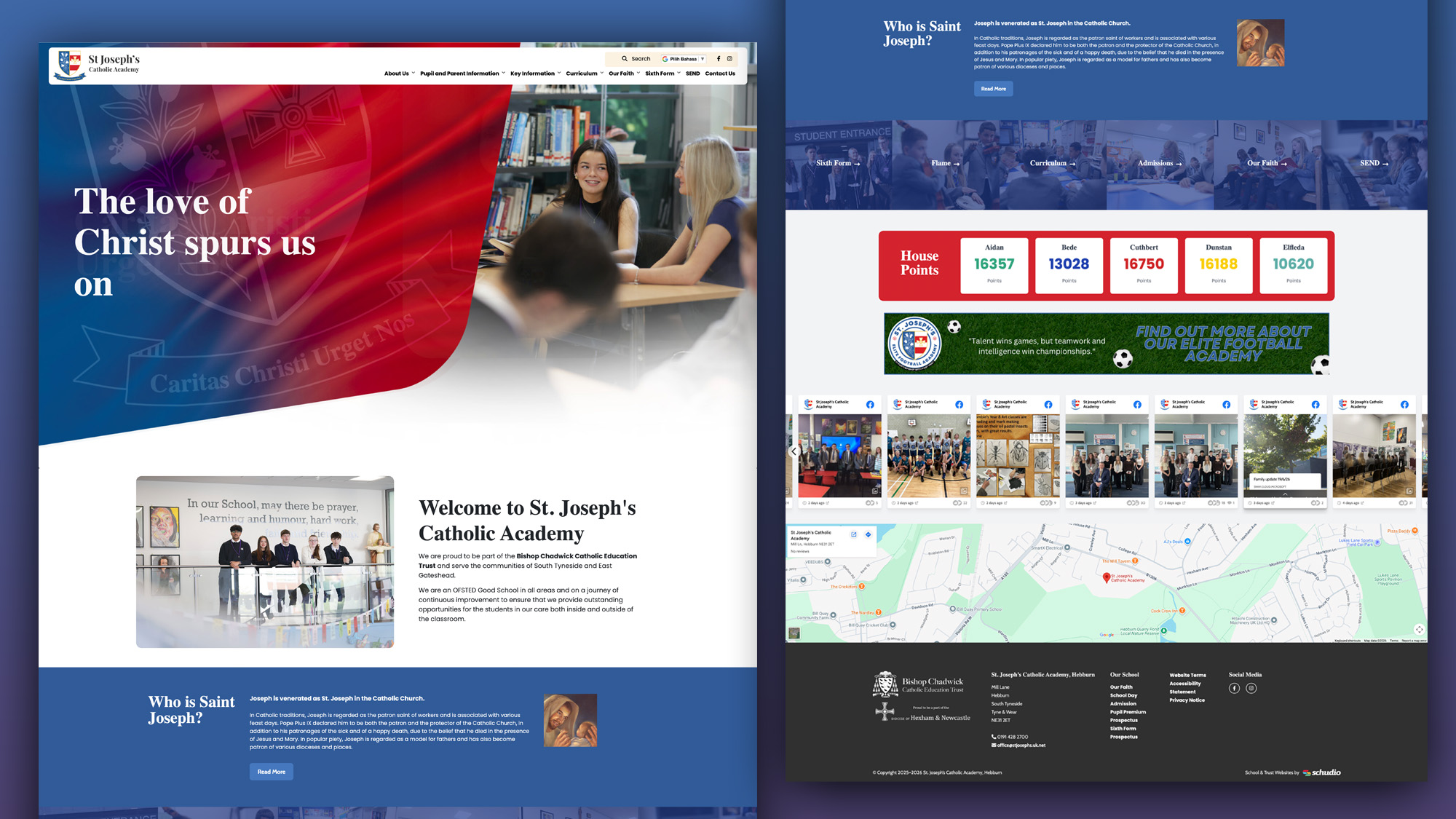
A well-designed school website acts as the central hub for communication.
Parents use it to find practical information. Current students access resources and updates. Prospective families explore the school environment and culture. Even prospective staff may visit to understand what the school feels like day to day.
An effective school website improves communication across the school community by making the right information easy to access at the right moment.
That includes:
- Publishing school news and news updates
- Highlighting recent events, celebrations, and school activities
- Sharing curriculum information such as reading schemes, key stage overviews, and subject detail
- Providing contact details and clear routes to the right person in the school staff team
Basic details like school name, address, and contact details should be immediately visible. A contact form helps too, since it lets parents send questions without guessing which inbox to use.
High-quality photography matters here. A school website should include up-to-date, professional photos that reflect real school life and the real school environment. It helps build a strong first impression for prospective families, and it supports the confidence parents feel when they land on the site.
Compliance adds another layer
Alongside communication, every maintained school has a set of legal requirements for what must be published online.
Every maintained school must publish specific information on its website to comply with legal requirements. Schools that do not have their own website must publish required information on an alternative website and provide parents with a link to it.
A clear structure matters even more here, since statutory information needs to be easy to find and easily accessible.
A practical list of common statutory information includes:
- Admission arrangements (schools must publish their admission arrangements each year for children starting school in September)
- A timetable for organising and hearing admission appeals (schools must publish this annually)
- Behaviour policy (required under the Education and Inspections Act 2006)
- Complaints policy (required under the Education Act 2002)
- An SEN information report (updated annually under the Children and Families Act 2014)
- Governance information about the governing body and committees
- Ofsted reports
- Financial information such as pupil premium and sport premium spending
This is where many school websites become cluttered. Policies are uploaded, but the navigation grows messy. Links are buried. Pages become long lists of downloads without context.
A clear layout helps here: an organised policy index, sensible grouping, and quick access to key information without sending parents into a maze.
The impact on school staff
The blank page problem affects parents, but it hits school staff too.
Creating pages from scratch takes time. School staff end up spending admin time deciding how to lay out information and what headings to use, rather than simply updating what needs updating.
When updates take longer, they happen less often. Then content becomes less regularly updated. Then the website starts to feel out of date, and that affects confidence.
A good content management system should support staff with limited technical knowledge. It should make creating and updating pages straightforward, with clear sections and consistent layouts that reduce decision fatigue.
This is where structure supports real work. It protects staff time, and it keeps the site feeling current.
Mobile users and modern expectations
Many website visitors now access a school website on mobile devices.
Parents may check the site on a mobile phone during the school run. Prospective families might browse on the sofa in the evening. Students might check a link from a phone or tablet.
So mobile responsiveness matters.
A school website needs to be mobile-responsive across screen sizes, with layouts that remain readable and easy to use on phones and tablets. Mobile-responsive pages also help accessibility.
Accessibility deserves real attention, not box-ticking. A school website should support screen readers, provide alt text for images, and offer high-contrast options that align with WCAG 2.1 expectations. Keyboard-friendly navigation helps users who don’t use a mouse, and it improves overall usability.
A site that works well on mobile devices and supports accessibility is not just better for parents. It’s better for everyone.
Security and trust
There’s another practical layer that schools can’t ignore: security.
SSL certificates are essential for protecting data on school websites, especially where forms collect personal details. Even if you’re not handling student records directly through the public site, parents still submit information through contact forms, absence reporting forms, and enquiries.
Schools often use secure portals for students and parents, and that’s sensible. Those areas should sit behind secure access, with clear signposting, so parents and students know where to go.
News, school life, and why freshness matters
One area where structure really matters is the news section.
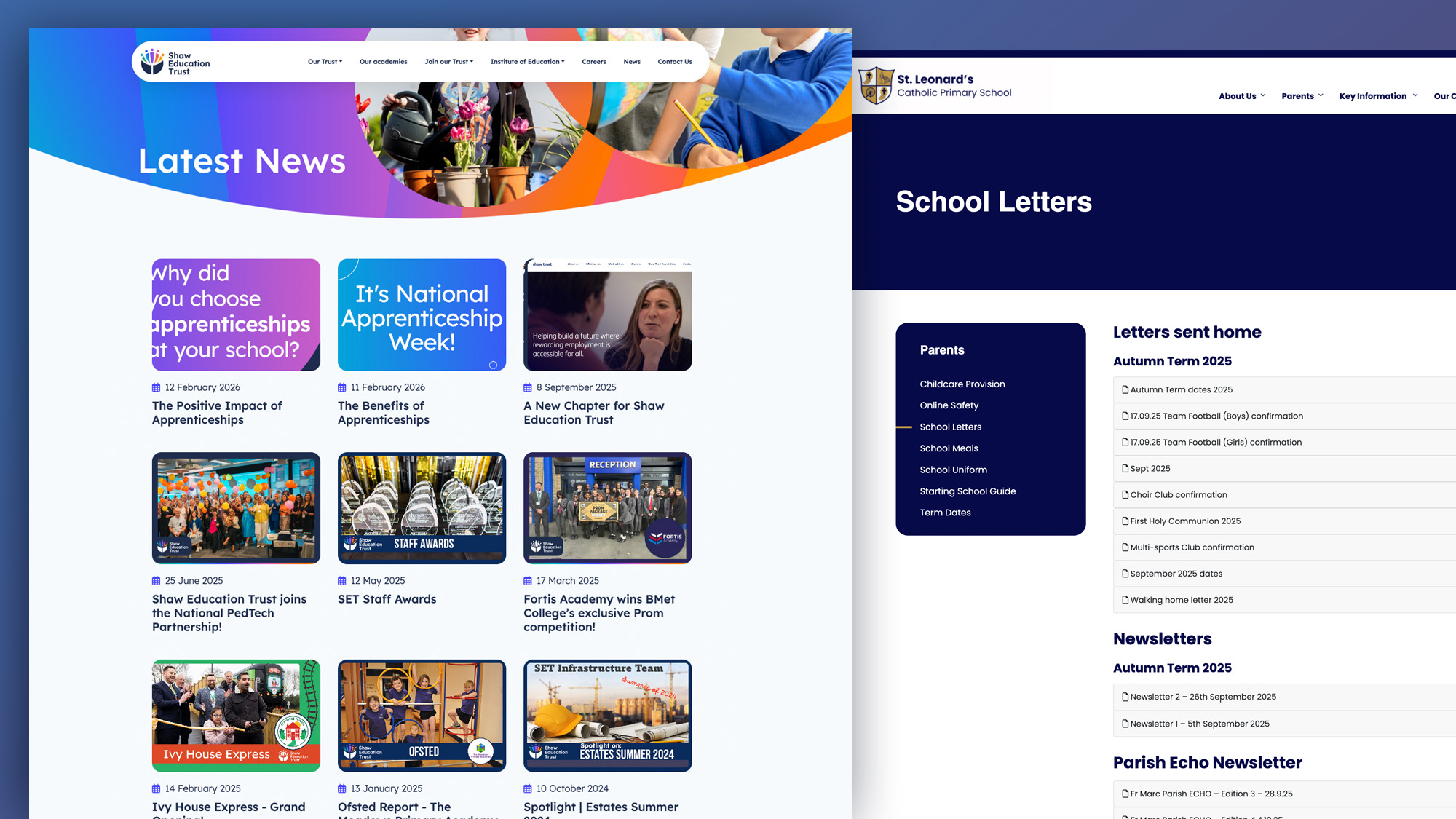
School news is often the heartbeat of a school website. A school news page gives parents a window into school life, and it helps prospective families understand the day-to-day atmosphere.
When school news is regularly updated, it gives a positive first impression. It says: this school is active, organised, and proud of what’s happening.
News posts might cover:
- School events
- Sports days and sports fixtures
- Trips, clubs, enrichment, performances
- Celebrations and student achievements
- Wider community involvement and local community partnerships
Multimedia galleries help a lot here. Photos and videos bring school activities to life, and they show the school environment far better than paragraphs ever will.
Authentic photography beats stock images every time. Parents can tell when a photo reflects real school life. It builds trust quickly, and it supports the school’s identity.
Social media can support this too. A live feed, or simple integration, helps share news updates in a way that feels current, and it gives families quick, real-time updates. Social media can’t replace good website content, but it can amplify it.
Top tip: Keep the number of top-level links in the main menu under control. Too many menu items make navigation clunky, especially on mobile devices. A smaller set of clearly labelled options nearly always improves user-friendly browsing.
Curriculum pages and the blank page trap
Curriculum pages are a classic example of how blank-page writing creates complexity.
Schools are expected to publish curriculum information, and parents often want more than a PDF. They want clarity on what their child will learn, how subjects are structured, and what progression looks like across the academic year.
A strong curriculum area often includes:
- A simple overview of the approach
- A clear breakdown by key stage
- Year group details
- Notes on reading schemes and how reading is taught
- Subject coverage, including religious education and other mandatory subjects
When this is built from scratch each time, schools end up with wildly different formats across subjects. That’s confusing for parents, and it makes the site harder to maintain.
A consistent structure keeps everything clearer for parents and reduces staff effort when updating.
Why prospective families feel it most
Prospective families are usually doing two things at once:
- Trying to get a feel for the school’s identity
- Trying to check practical details
They are looking for signs of a good school: warmth, standards, community, calm organisation, and a sense that the school environment will suit their child.
They also want clarity:
- Term dates
- Admissions information
- Who to contact
- What school life is like
- What the school community feels like
That’s why your school website needs to balance storytelling with structure. It can be welcoming and human, without being messy.
Some schools use virtual tours to help here. A short tour can help prospective families explore the site and the school environment remotely, especially if they can’t visit easily. It’s not essential for every school, but used well, it can support first impressions.
Moving past the blank page
Starting with a blank page feels flexible, but it often creates unnecessary work.
It forces staff to reinvent the structure every time they create or update content. It creates inconsistent pages. It creates longer writing than needed. It creates more questions for parents.
A consistent structure changes everything:
- School staff know where to put key information
- Parents know where to find it
- Students can access resources quickly
- Prospective families can understand the school’s identity and school life faster
- Content is easier to keep regularly updated
It also supports maintenance. Regularly reviewing old content helps keep the site up to date and reduces the risk of missing statutory information.
Looking ahead
Many schools assume that improving their school website means starting from scratch.
In practice, the biggest improvements often come from better structure and clearer navigation.
When key pages follow a simple, consistent layout, the whole site becomes easier to maintain. Parents find what they need. Students get access to resources. Prospective families gain confidence. School staff spend less time answering the same questions.
In the next posts, we’ll keep building on this, looking at practical examples of what “good” looks like on key pages, including:
- Admissions pages that are easy to follow
- A head teacher’s welcome page that builds trust quickly
- Curriculum pages that make key stage information clearer
- Site structures that help parents and website visitors find what they need without frustration
Once the structure is right, creating school website content becomes much easier.
And that’s when a school website starts doing what it’s meant to do: supporting the whole school community, day in, day out.

Related Posts
Ian Richardson
October 7, 2026
What a school website chatbot should answer, what it should never answer, and how to get your pages ready before you switch one on. A guide for leaders.

Ian Richardson
September 30, 2026
What schools should not use AI for, the AI safeguarding risks behind each limit, what KCSIE 2026 now says, and a practical checklist for school leaders.

Ian Richardson
September 16, 2026
Introducing the Schudio AI Suite: AI school website software that checks what you publish, drafts pages in your school's voice and answers parents' questions.
Ian Richardson
July 29, 2026
What parents look for in a school, and how your website answers it before they visit: culture, safeguarding, SEND support and clear practical information.
Ian Richardson
June 24, 2026
A school website says a lot before a parent reads a full page. Parents make ..
Luke Smith
June 24, 2026
School website news is one of the easiest ways to show parents, pupils and prospective ..