How to Structure a School Admissions Page That Converts Parents Effectively
How to Structure a School Admissions Page That Converts Parents Effectively
If there’s one page on your website that really matters, it’s your school admissions page.
This is the point where parents stop browsing and start making decisions.
And yet, across most schools, this is still one of the hardest pages to use.
Not because the information isn’t there.
But because the way it’s presented makes the admissions process feel far more complicated than it needs to be.
Parents Aren’t Reading. They’re Trying to Apply.
When parents land on your admissions page, they’re not reading it like a document.
They’re trying to apply for a school place.
They want to:
- work out what to do
- understand the process
- check key dates
- make a decision
That’s it.
If your page doesn’t help them do those things quickly, they feel it straight away.
And when that happens, they either leave… or they contact the school.
What Parents Are Actually Trying to Find
From working with schools across the UK, this is what parents are usually looking for when they visit a school admissions page:
- How to apply for a school place
- Key dates for the school year
- Whether they are likely to be offered a place
- What the admissions criteria are
- When open days are happening
- Who to contact if they are unsure
This applies whether it’s a primary school, secondary school, junior school, or even a university technical college.
The need is always the same:
“Help me understand what I need to do next.”
Where Most School Admissions Pages Go Wrong
The issue isn’t a lack of information.
Most schools provide:
- detailed policies
- full admissions criteria
- correct local authority links
- accurate application guidance
But the experience for parents still breaks down.
Common problems include:
- no clear starting point
- multiple links to external sites with no explanation
- key dates hidden in long paragraphs
- outdated documents still visible
- admissions information spread across several pages
So instead of helping parents, the page creates friction.
The Reality of the Admissions Process
Let’s be clear about something.
The school admissions process in England is already complex.
For example:
- Applications for primary school places open in September and close on 15 January
- Applications for secondary school places usually open on 1 September and close on 31 October
- Missing a deadline can mean a child is less likely to be offered a place
Parents are already navigating:
- local authority systems
- preference lists
- oversubscription criteria
- appeals
Your website should reduce that complexity.
Not add to it.
A Better Way to Structure Your Admissions Page
Instead of thinking about what to include…
Think about how parents move through the process.
Here’s a structure that works.
1. Start With Clarity
Right at the top of the page, answer one simple question:
Who is this page for?
For example:
- Applying for Reception in September 2026
- Applying for a secondary school place
- Moving schools during the school year
This helps parents immediately find their route.
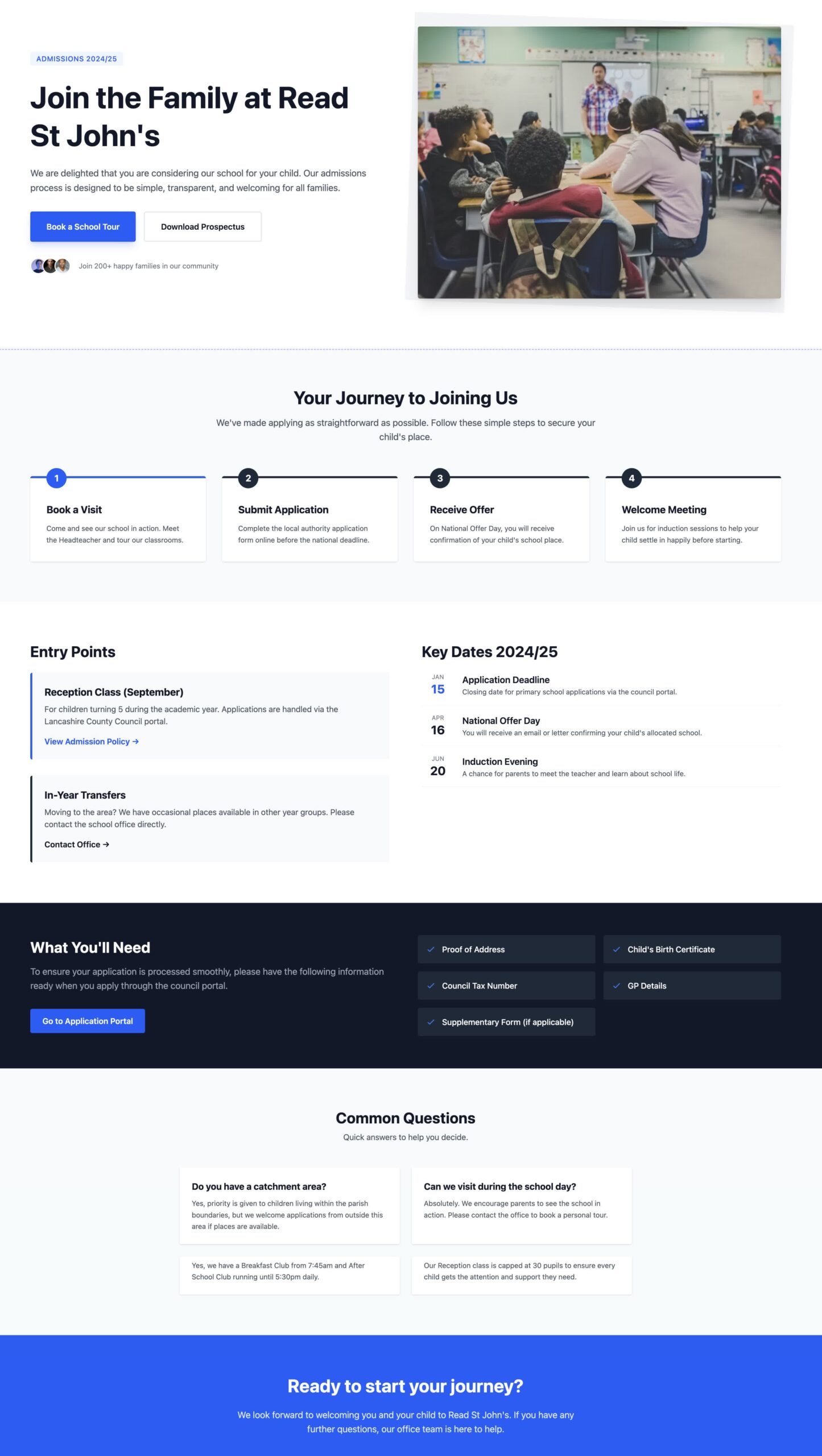
2. Add a “Start Here” Section
This is where most schools miss a huge opportunity.
Parents shouldn’t have to scroll to work out where to begin.
Give them clear options:
- Starting school
- Moving school
- Applying in-year
Each option should guide them forward.
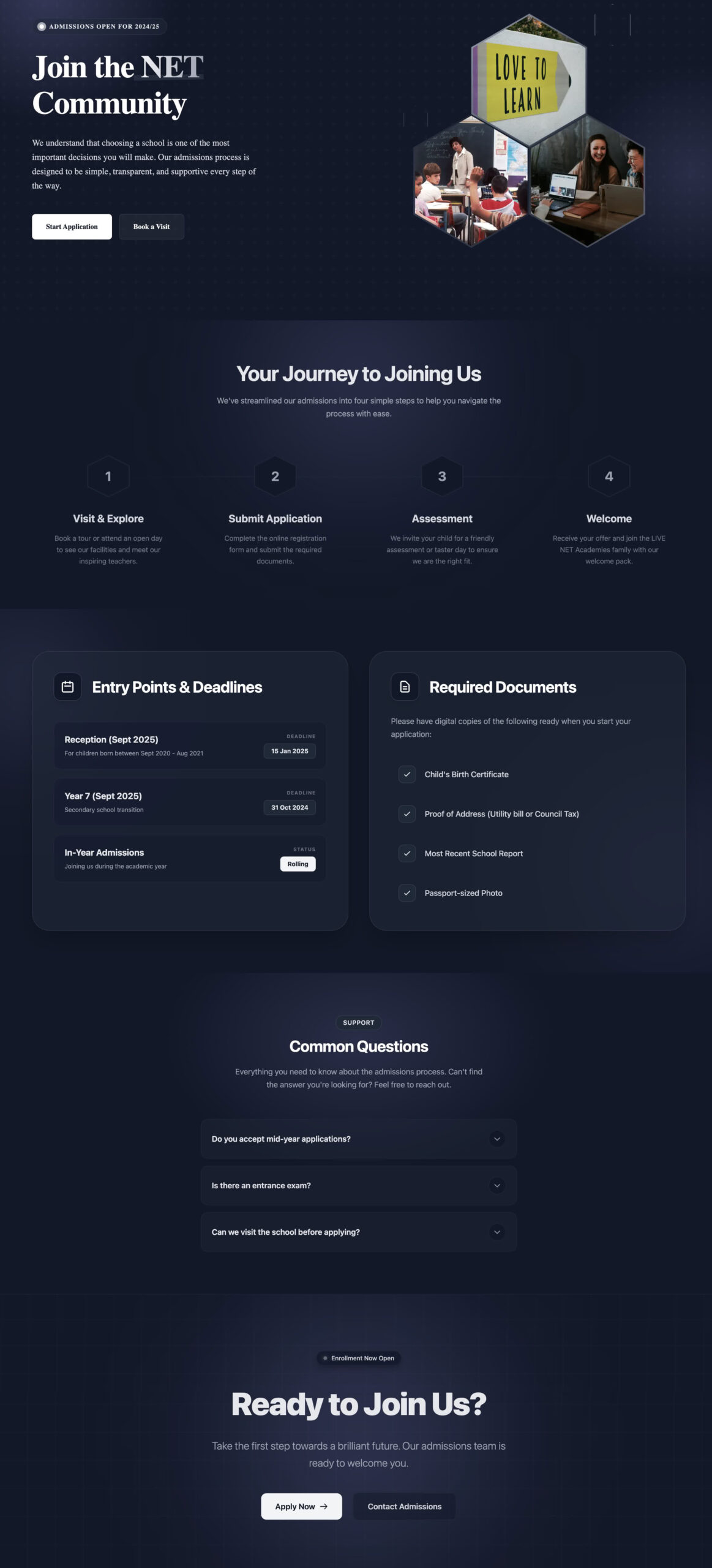
3. Break the Process Into Steps
Parents don’t want a long explanation.
They want a clear process.
For example:
Step 1 – Check if this applies to you
Explain who should use this section
Step 2 – Apply through your local authority
Include the correct link and explain it
Step 3 – Key dates
Make deadlines obvious
Step 4 – What happens next
Explain how places are offered
This is what turns a confusing page into a useful one.
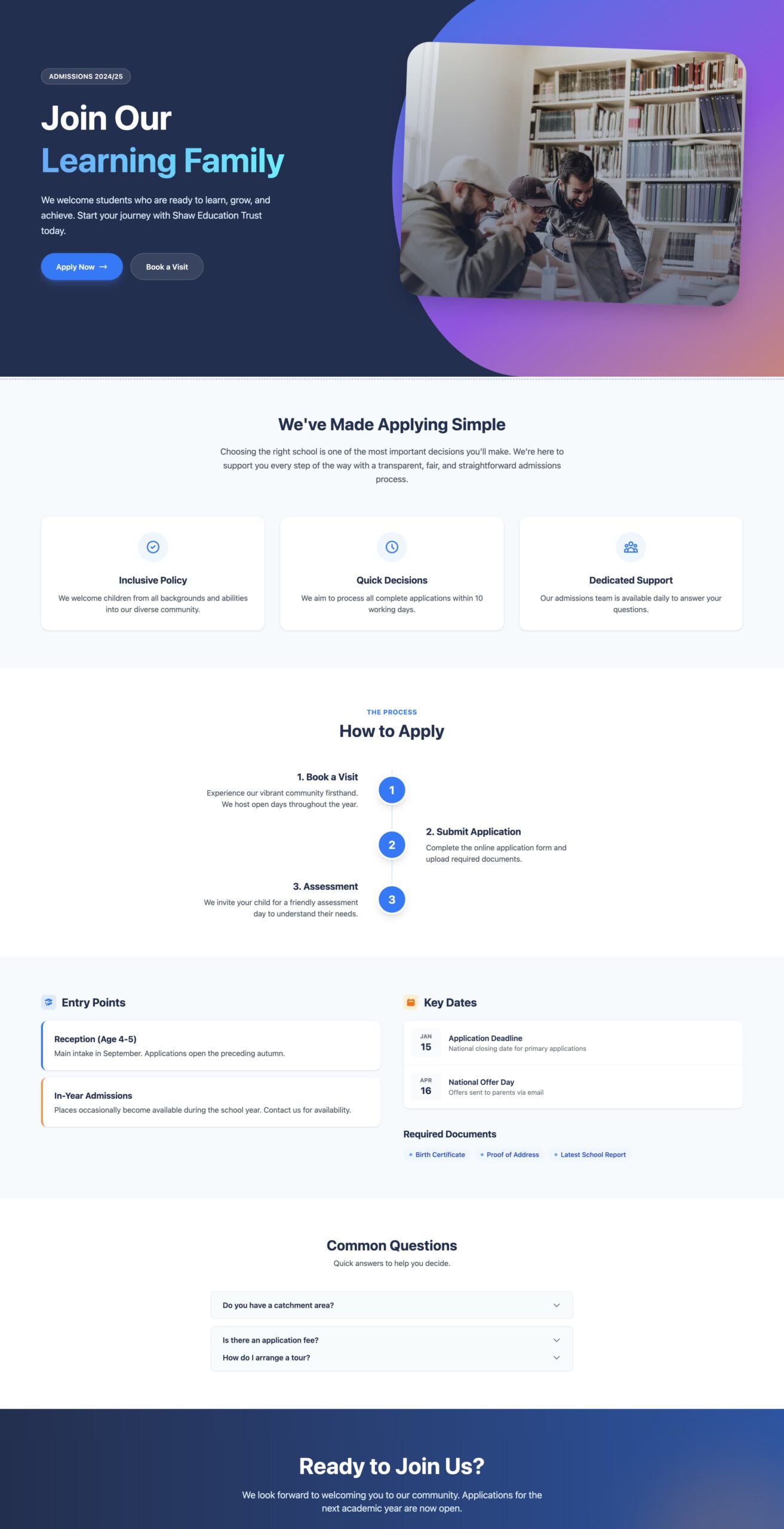
4. Make Key Dates Impossible to Miss
Dates are one of the most important parts of school admissions.
Parents need to track:
- application deadlines
- offer dates
- appeal windows
- open days
For example:
- Secondary school applications close on 31 October
- Primary school applications close on 15 January
- National Offer Day usually happens in March or April
If parents cannot find the date easily, they lose confidence.
5. Explain How Places Are Allocated
This is where many parents feel unsure.
They want to understand:
- how decisions are made
- what increases their chances
- what happens if they don’t get their first choice
A simple explanation helps:
- proximity to the school
- siblings already attending
- published admission number (PAN)
- catchment area
You don’t need to simplify the policy.
Just explain it clearly.
6. Include Practical Application Guidance
Parents often don’t know what they need.
Help them prepare.
For example:
- apply using the Common Application Form (CAF)
- list schools in order of preference
- provide proof of address
- provide proof of the child’s identity
This removes uncertainty.
7. Cover In-Year Admissions Clearly
Moving schools is a different process.
Parents need to know:
- how to apply
- who to contact
- what information is required
For in-year admissions:
- parents usually contact the local authority
- they may need supporting documents
- the child will typically start the next term
This needs its own section.
8. Make Appeals Easy to Understand
If a parent isn’t offered a place, they need to know what to do.
Explain clearly:
- how to appeal
- where to submit it
- what the timeline is
Parents should know:
- they can attend an appeal hearing
- they can present their case
- they will receive a written outcome
This builds trust.
9. Add Clear Contact Options
At some point, parents will still need help.
Make it easy:
- clear contact details
- simple contact routes
- a named contact if possible
Good communication makes a huge difference here.
Why This Structure Works
When a school admissions page is structured properly:
- parents find information faster
- the process feels simpler
- confidence increases
- more parents complete applications
And internally:
- fewer phone calls
- fewer repeated questions
- better use of staff time
The Role of Open Days
Open days are a key part of the decision process.
Parents want to:
- visit the school
- explore the environment
- understand the school’s values
Your page should:
- clearly list open days
- include booking details
- make it easy to take the next step
This is where your admissions page starts to convert.
Why This Matters More Now
With changes across the education system and falling birth rates in many areas, schools are competing more for places.
Your admissions page is no longer just informational.
It plays a key role in:
- attracting prospective families
- supporting decision-making
- improving outcomes
A well-structured page makes a huge difference.
A Simple Test
Open your admissions page and ask:
- Can a parent find what they need in under 30 seconds?
- Is the process clear?
- Are the key dates obvious?
- Is there a clear next step?
If not, there’s a gap.
One Final Thought
Most schools don’t need more admissions content.
They need better structure.
The information is already there.
It just needs to be easier to use.
What This Leads To
This is exactly why we’ve been rethinking how schools build their website pages.
Instead of starting from scratch every time…
We’ve been building structured templates based on how parents actually move through a page.
Starting with:
- Headteacher welcome pages
- Admissions pages
- Curriculum pages
Each one built around clarity, structure, and real journeys.
We’ll be sharing more on that very soon.
Summary
A strong school admissions page should:
- guide parents through the process
- make key information easy to find
- highlight important dates
- explain how decisions are made
- support parents at every stage
When that happens, everything improves.
Parents feel confident.
Schools reduce pressure.
And more families take the next step.

Related Posts

Ian Richardson
September 30, 2026
What schools should not use AI for, the AI safeguarding risks behind each limit, what KCSIE 2026 now says, and a practical checklist for school leaders.

Ian Richardson
September 16, 2026
Introducing the Schudio AI Suite: AI school website software that checks what you publish, drafts pages in your school's voice and answers parents' questions.

Ian Richardson
July 29, 2026
What parents look for in a school, and how your website answers it before they visit: culture, safeguarding, SEND support and clear practical information.
Ian Richardson
June 24, 2026
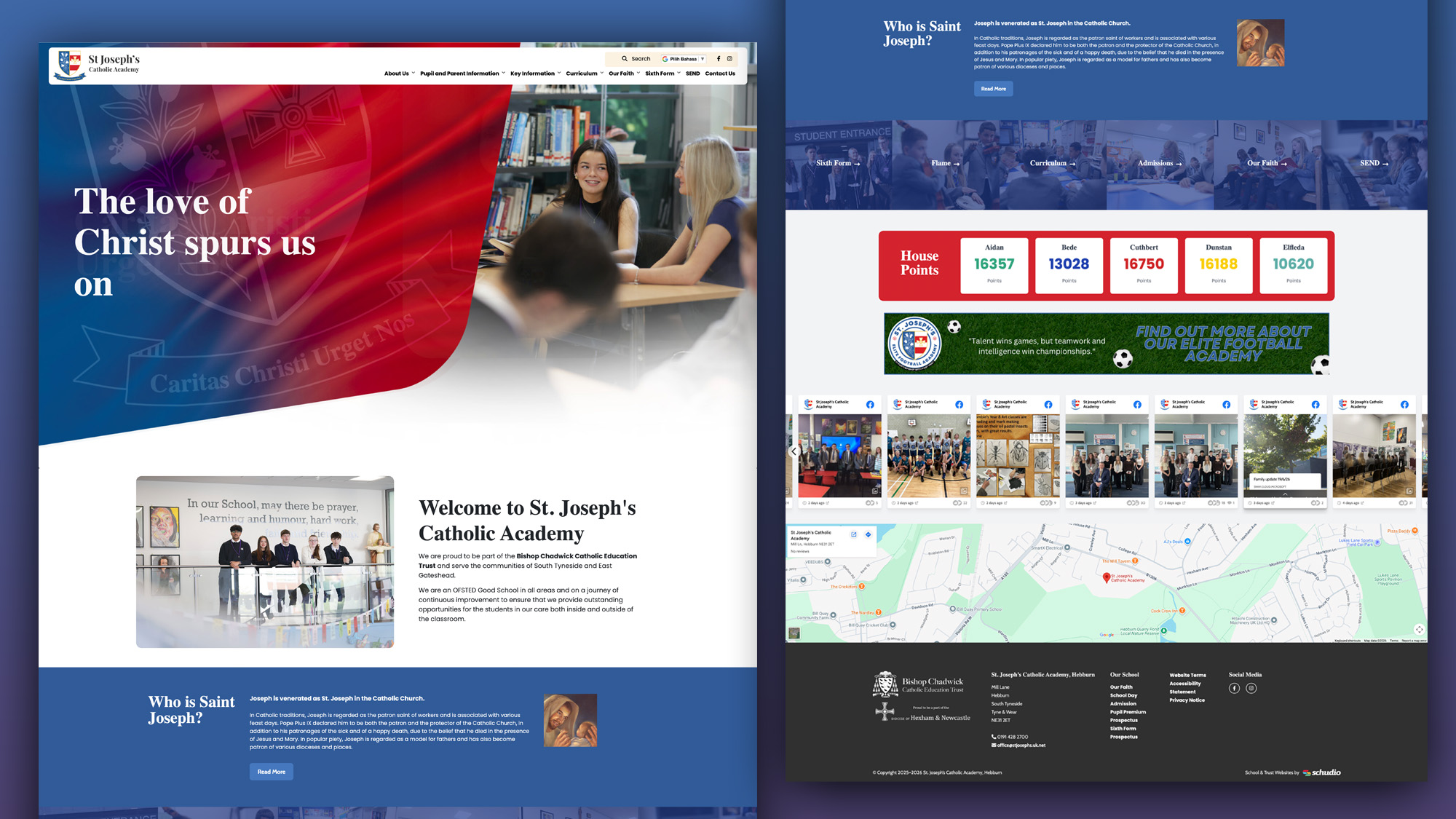
A school website says a lot before a parent reads a full page. Parents make ..
Luke Smith
June 24, 2026
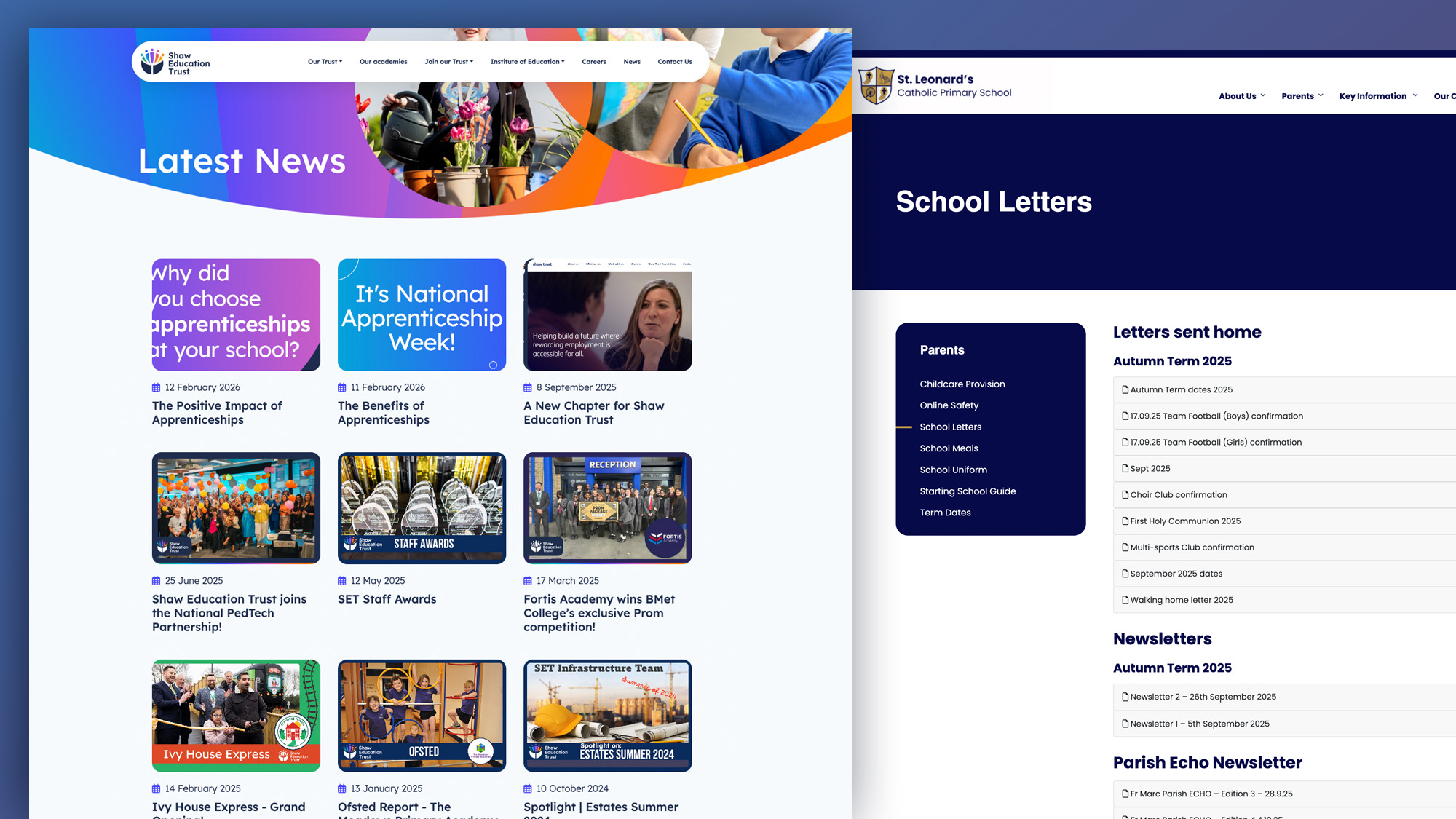
School website news is one of the easiest ways to show parents, pupils and prospective ..

Luke Smith
June 17, 2026
A school website newsletter is one of the simplest ways to keep parents informed, make ..