Rethinking How Schools Build School Website Pages
Rethinking How Schools Build School Website Pages
Over the last few months, I’ve found myself coming back to the same conversation again and again.
It usually starts off quite small.
“We just need to update a few school website pages…”
And then, within about five minutes, it becomes clear that it’s not really about updating a page at all.
It’s about how the whole school website has been built.
And more specifically…
Where it all starts.
The bit no one really talks about
Most people don’t talk about this part.
But it’s where everything begins to go wrong.
You open your content management system.
You click “create page”.
And you’re staring at a blank screen.
Now you’ve got to:
- brainstorm ideas for what goes on the page
- think about structure
- think about what parents need
- remember compliance requirements
- make it work across mobile devices and desktop computers
- make it visually appealing
- and try to make it feel like a well designed school website
All at the same time.
That’s a lot to ask of anyone.
Even in the education sector where teams are experienced and committed.
Why this matters more than it sounds
This isn’t just a small process issue.
It shapes everything.
Because when every page starts blank, every page becomes different.
Across most school websites, you end up with:
- different layouts across pages
- inconsistent navigation
- inconsistent display of content
- duplicated key information
- content that doesn’t quite connect
And even when the school website content is good…
The experience isn’t.
What we see across most school websites
We spend a lot of time looking at school website designs.
Primary, secondary school, multi academy trusts, trust website structures, all of it.
And honestly, most school websites are trying to do the right thing.
They include:
- school news
- school events
- curriculum information
- contact details
- policies
- admissions information
They are doing what’s expected.
But they still don’t become a great school website.
Not because they’re missing content.
Because they’re missing structure.
Parents don’t see pages the way schools do
This is the bit that changes everything.
Schools think in pages.
Parents don’t.
Parents move through a school website.
They:
- land on the homepage
- click into admissions
- jump to key information
- look for school events or upcoming events
- check contact
- go back and search again
They follow a path.
A well-designed school website guides users effectively with clear navigation, ensuring visitors can easily find what they need.
And if that path isn’t clear, they feel it immediately.
Clear navigation on school websites helps parents find key information easily.
When that’s missing, even the best school websites struggle.
A quick example
Let’s take something simple.
Term dates.
In a lot of schools, this might exist:
- on one page
- inside a PDF
- mentioned in a newsletter
- referenced in school news
That’s four places.
Now imagine a parent on a mobile phone trying to find information quickly.
They don’t care where it lives.
They just want the answer.
This is where structure matters more than content.
So we started asking a different question
Instead of asking:
“How do we help schools write better content?”
We started asking:
“What if the starting point was wrong?”
What if the problem wasn’t writing…
But how pages are created in the first place?
What if you didn’t start from scratch?
This is where things started to shift for us.
What if instead of:
- designing a page
- structuring it
- writing it
…you started with something already structured?
Something already aligned with:
- how parents navigate
- what Ofsted expects
- how a school website should work
Not locked down.
Not restrictive.
This approach gives schools full control over their content and page structure, while still providing a solid, well-considered foundation.
We started with three pages
Rather than trying to fix everything at once, we focused on the pages that matter most.
The ones that shape the experience straight away.
The ones that parents use first.
So for launch, we’ve focused on:
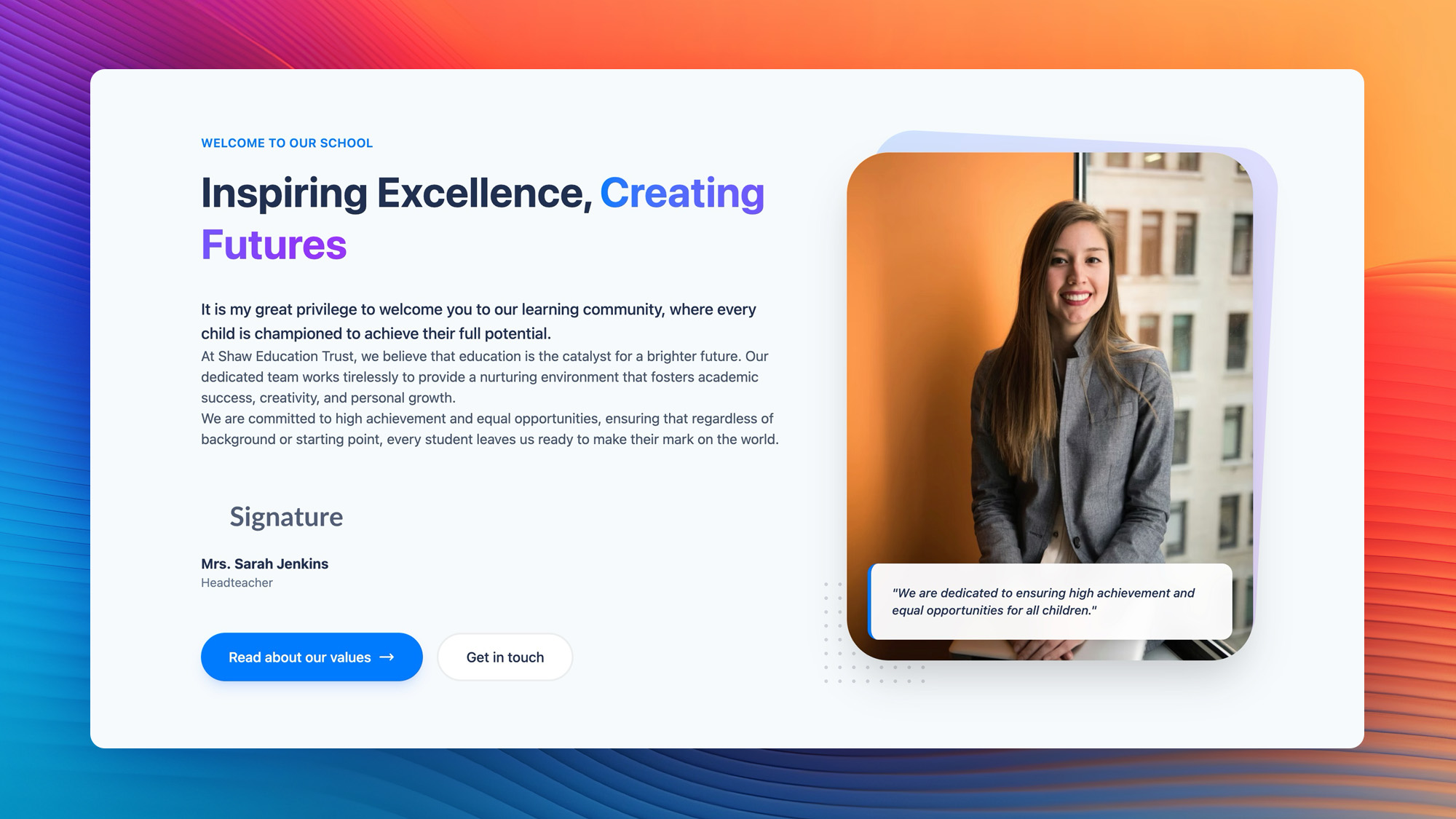
- Headteacher Welcome
- Admissions
- Curriculum
Headteacher Welcome
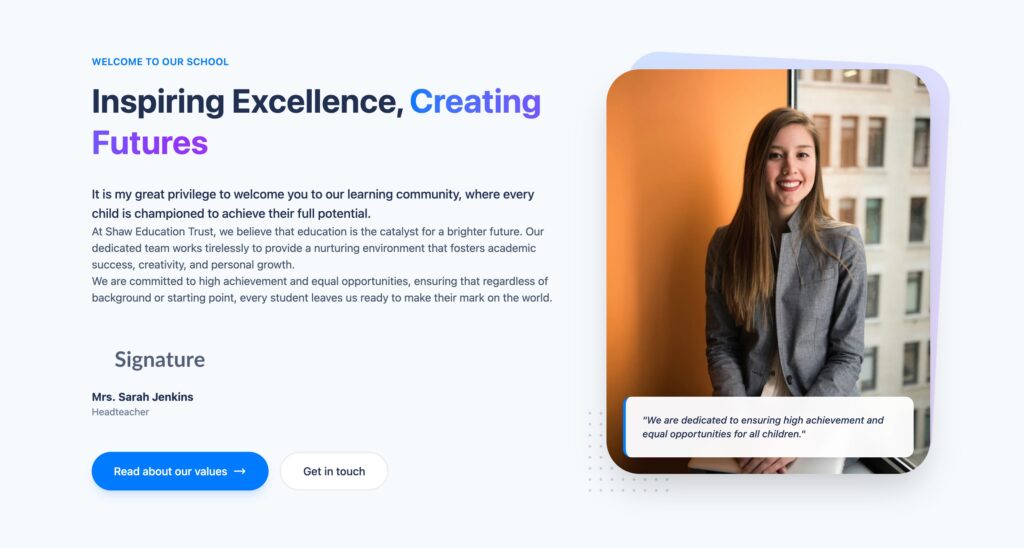
This is often one of the first pages prospective parents visit.
It sets the tone. Incorporating branding elements such as the school’s logo, emblem, and visual identity on this page helps reinforce the school’s values and create a strong, authentic impression.
It reflects the school’s values.
It gives a sense of the school community and what daily life feels like.
But what we often see is:
- long text
- written like a letter
- difficult to read on mobile
- no clear structure
So instead of starting from a blank page, this now has a clear shape.
Not to restrict what’s written.
But to help it:
- reflect the school’s ethos
- create an inviting experience
- guide visitors naturally
A school website should reflect the school’s values and ethos through both design and content. Using engaging photography and clear messaging on this page is essential to effectively convey these values to visitors.
This page is a big part of that.
Admissions
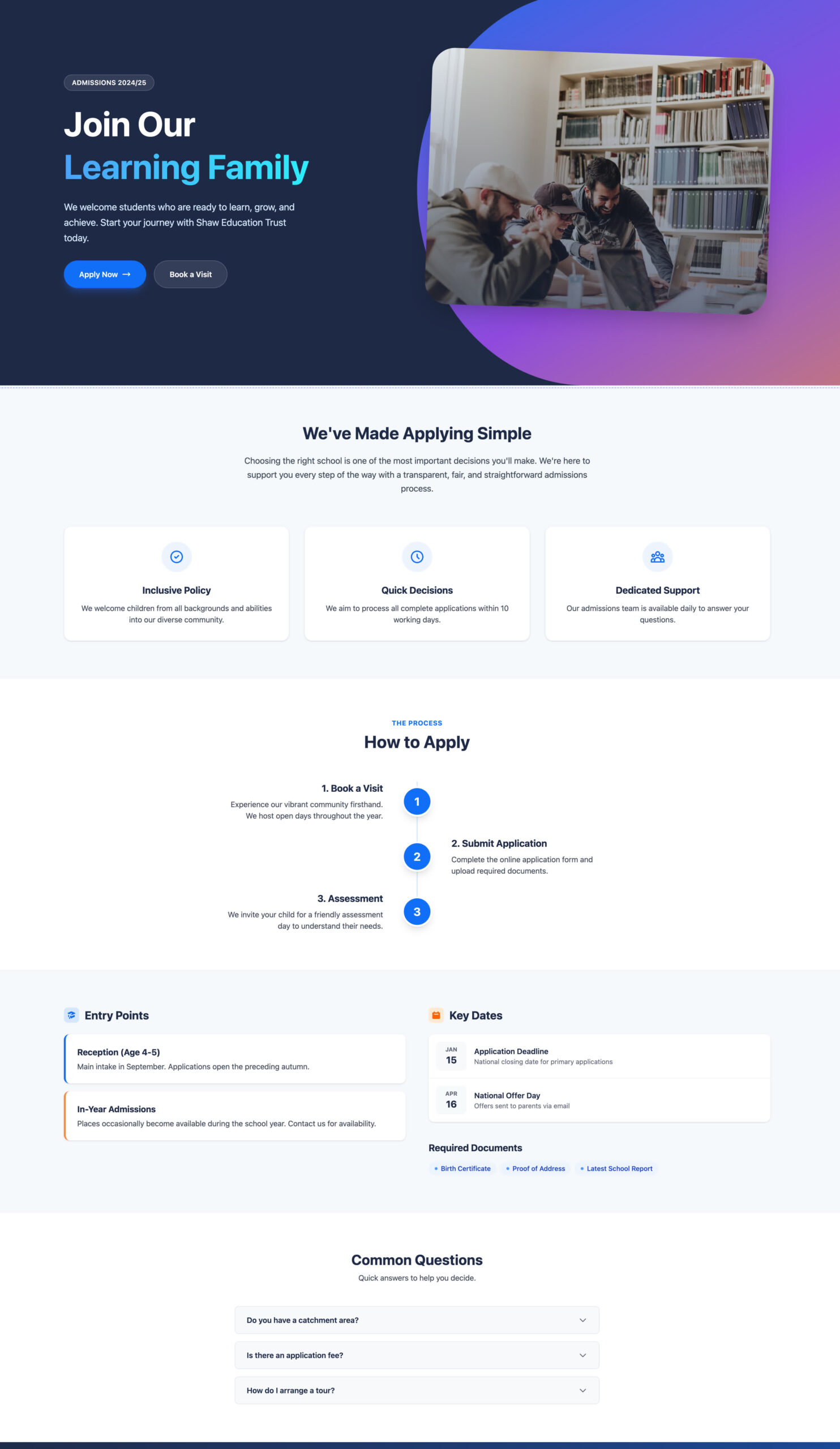
This is where most school websites either work…
Or break.
Because parents are not just reading here.
They are trying to act.
They want to:
- understand the process
- see key dates
- know what to do next
And yet what we often see is:
- long explanations
- multiple links
- unclear journeys
So this has been structured around how parents actually think.
Step-by-step.
Clear calls to action.
Key information where it matters.
Because a school website is one of the most effective marketing tools for attracting prospective families.
And this is the page where that really matters.
Curriculum
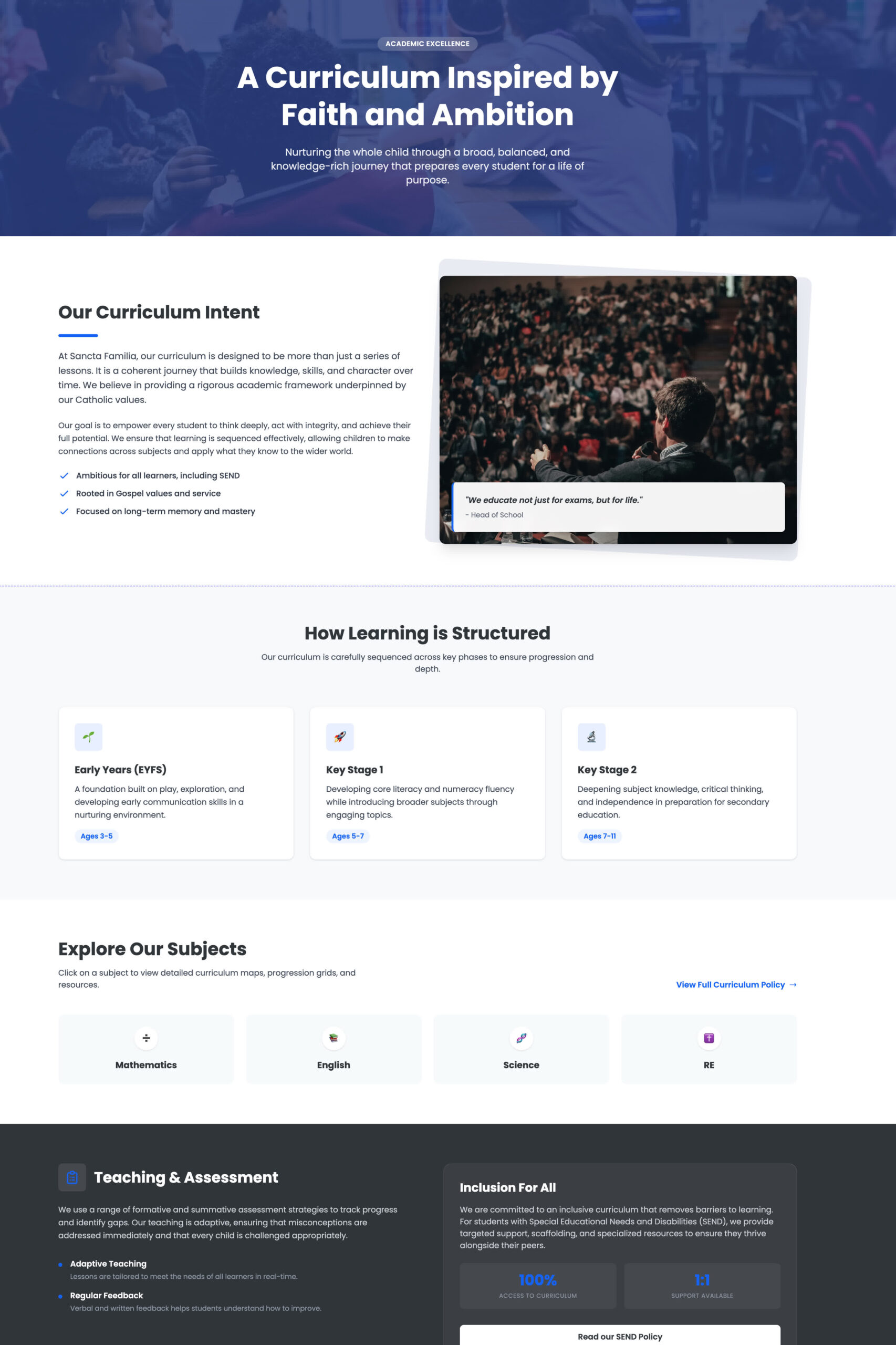
This is probably the hardest one to get right.
Because it has to balance:
- compliance
- clarity
- communication
- showcasing learning
And in many school website designs, it becomes:
- lots of text
- lots of PDFs
- difficult to navigate
So again, this is about structure.
Breaking things down into:
- clear sections
- subjects or key stages
- supporting materials
- extra curricular activities
- logical flow
Curriculum sections should clearly outline subjects, reading schemes, and learning pathways so parents and students can understand them easily.
This isn’t about simplifying the curriculum.
It’s about making it accessible.
What this changes
This changes the job completely.
Instead of thinking:
“What do I need to create?”
You’re thinking:
“How do I complete this?”
And that’s a much easier place to start.
Because:
- the structure is already there
- the layout already works
- the journey is already thought through
So your team can focus on:
- content
- accuracy
- clarity
Why this matters for your team
This has a direct impact on workload.
Because when pages are consistent:
- it’s easier to update pages
- it’s easier to manage content
- it’s easier to stay compliant
User-friendly CMS platforms allow schools to manage content without needing technical expertise.
Additional services, such as training and technical support, can further ease the workload for school teams by ensuring they have the help they need when managing their school website pages.
A custom CMS can provide schools with centralized control over their website content, enhancing management efficiency.
And that matters.
Because most teams don’t have time to constantly rethink structure.
Why this matters for parents
Parents expect:
- quick answers
- clear navigation
- mobile friendly access
- consistent experience
Responsive design is essential so school websites work across all screen sizes and devices. Compatibility with any device—whether desktop, tablet, or smartphone—ensures ease of use, smooth navigation, and visual appeal for every user. A responsive content management system (CMS) is also essential to guarantee accessibility and functionality on all devices.
A school website should help families stay connected with school life.
When it does that well:
- communication improves
- trust builds
- engagement increases
And yes… compliance matters too
There’s no getting around it.
A school website must include:
- behaviour
- attendance
- safeguarding
- curriculum
- policies
- governance information
To comply with UK regulations, school websites must publish key policies, performance data, and admissions information.
Ofsted requires this. Ofsted requires school websites to provide specific information for transparency and accountability.
GDPR requires data protection. School websites must comply with GDPR regulations to protect personal data. A privacy policy should be in place outlining how personal data is collected and used.
Accessibility standards must be met. Regular updates to school websites are necessary to maintain compliance with Ofsted and GDPR requirements.
That includes:
- readable content
- alt text, high-contrast text, and font size adjustments
- structured navigation
A well structured site makes all of this easier.
Search engine optimisation (SEO) should be incorporated from the start to ensure compliance and maximise visibility in search results.
Looking at the best school websites
When you look at the best school websites, you notice something.
They don’t feel complicated.
They feel:
- clear
- structured
- easy to use
They combine:
- strong content
- clean layout
- good website design
- consistent structure
They are visually appealing. The best school website pages use modern design elements, effective white space, and visually stunning layouts to create a strong first impression for all members of the community. A stunning school website showcases innovative features and design trends, helping your school stand out online.
But more importantly…
They work.
This is just the beginning
We’re starting with those three pages.
But that’s not where this stops.
Over the next few weeks, we’ll be releasing:
- newsletter-style page sections (moving away from PDFs)
- compliance-focused sections
- reusable components for across the site
- structured layouts for school news and school events
We’re also adding dynamic content, such as news updates and events, to keep school website pages engaging for parents.
And a lot more after that.
Why we’ve done this
If I’m honest, this has come from a bit of frustration.
Seeing really good schools…
Putting in a lot of effort…
And still feeling like their website is harder than it should be.
And realising it wasn’t about content.
It was about the starting point.
Final thought
A great school website isn’t built by chance.
It’s built with:
- clear structure
- consistent layout
- thoughtful design
When that’s in place:
- content becomes easier
- parents can navigate properly
- staff save time
- the whole school community benefits
A well-designed own school website not only supports teachers and staff but also powerfully showcases the school’s values to both the local community and the wider community. This strengthens the school’s identity, improves engagement, and serves as one of the most effective marketing and enrollment tools for attracting prospective students.
And it all starts with where you begin.

Related Posts
Harry
March 27, 2026
When parents visit a school website, they are not browsing. They are trying to find ..
Ian Richardson
March 19, 2026
If you’ve ever sat down to update your school website, you’ll probably recognise this. You ..

Ian Richardson
March 10, 2026
When someone lands on a school website for the first time, there are a few ..

Ian Richardson
March 5, 2026
You know that feeling when you’ve finally found a quiet moment to update a ..

Ian Richardson
March 2, 2026
When we carry out a school website review, one thing becomes clear very quickly. Most ..
Ian Richardson
February 23, 2026
Over the past few months, I’ve carried out a number of detailed school website reviews ..